

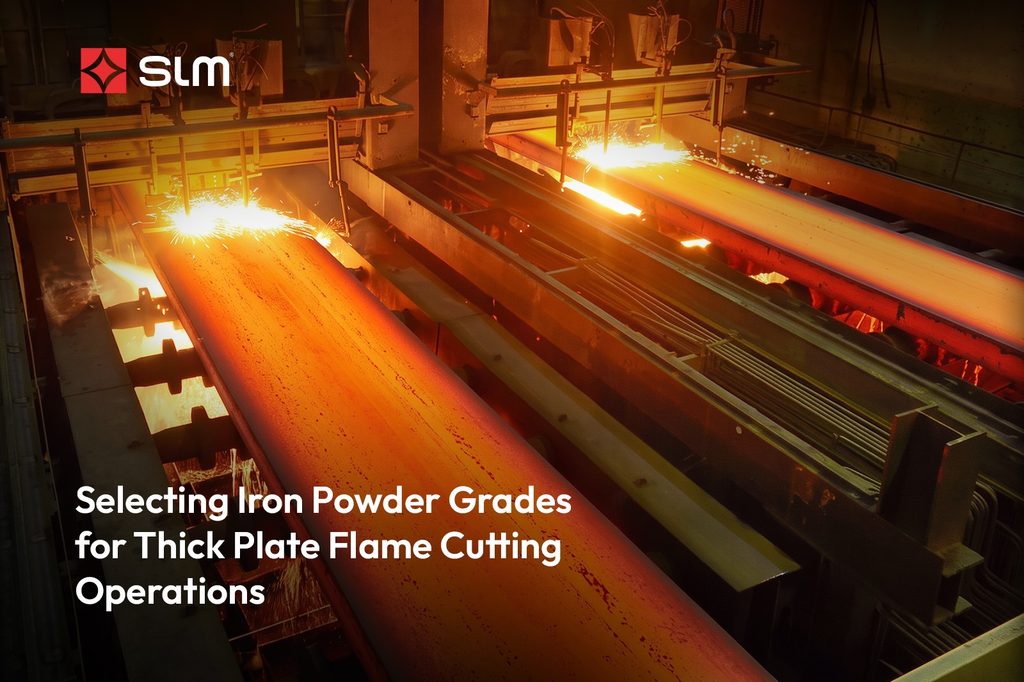
A thick plate has a funny way of exposing problems that never showed up on thinner sections. The torch hasn’t changed. Oxygen pressure is where it should be. Yet the cut slows down, slag builds up, or the edge comes out rough. The powder deserves a closer look. The grade of atomised iron powder you choose has a bigger influence than most people expect. It affects how steadily the process runs, how much powder gets consumed and, ultimately, the quality of the cut itself.
Heavy fabrication industries have relied on powder-assisted flame cutting for years. Shipyards, structural steel manufacturers, mining equipment builders and pressure vessel fabricators all deal with sections where maintaining enough heat gets harder as thickness increases. That’s exactly where iron powder earns its place.
Why Add Iron Powder at All?
Thicker plates absorb heat faster than thinner ones. The plate acts like a heat sink, drawing energy away from the cut. Iron powder makes up that difference. As particles oxidise inside the cutting stream, they release additional heat exactly where it’s needed.
If the particles don’t ignite properly, or aren’t fed uniformly, the process loses its rhythm fast. Cutting speed drops. Slag increases. Kerf quality varies from one section to another. By the time someone notices, the problem has already reached production.
Not Every Atomised Powder Behaves the Same
Two iron powders can look identical in a container. Similar chemistry, similar appearance, similar numbers on paper. Put them into the same cutting system and the results can differ sharply. Flame cutting depends on more than iron content alone. How the particles were produced, how uniformly they’re sized and how consistently they feed into the torch all shape performance. The differences aren’t obvious during inspection. They show up during production.
Particle Size Gets the Most Attention. Fair Enough.
Large particles don’t always oxidise fully before leaving the cutting zone, and some potential heat disappears with them. Very fine powders ignite quickly but create feeding inconsistencies, dust and handling issues. Neither extreme works well. Most thick plate applications need a controlled particle size distribution that balances ignition with sustained heat release, rather than one burst of energy.
Flowability Decides How Smooth the Day Goes
Feeding problems cause more production interruptions than people expect. A powder that bridges in the hopper or feeds unevenly changes the heat entering the cut every few seconds, and that shows up as inconsistent kerf width or incomplete penetration. This is where experienced iron powder manufacturers in India focus heavily: consistent particle shape and controlled size classification. When the feed stays consistent, the cut usually does too.
Purity Still Matters, Just Not for the Reason Most People Think
High iron content helps, but purity isn’t only about a number on a certificate. It’s about ensuring most of the material contributes to the oxidation reaction instead of carrying oxides, moisture or contaminants that add little useful heat. Cleaner powder also means fewer residues after cutting. One good batch doesn’t help much if the next one behaves differently.
Bulk Density Rarely Gets the Spotlight
Maybe it should. Two powders with similar chemistry can feed quite differently because they pack differently inside the feeding system. Consistent bulk density keeps delivery rates predictable over long runs, without operators constantly adjusting settings. This matters more in automated fabrication than squeezing out a little extra cutting speed.
Choosing the Right Grade
| Plate Thickness/Application | Suitable Powder Characteristics | Why It Works |
| Steel plates up to 50 mm | Medium particle size, good flowability | Stable combustion, efficient heat generation |
| 50-100 mm plates | Controlled particle size, narrow distribution | Better penetration, cleaner kerf |
| Plates above 100 mm | High purity, excellent feeding consistency | Sustains heat over long cycles |
| Automated cutting lines | Uniform bulk density, consistent flow | Fewer interruptions, better repeatability |
| Precision fabrication | Low moisture, controlled size, high purity | Cleaner edges, less slag |
The cheapest powder rarely turns out to be the least expensive option once cutting speed, consumption, rework and downtime are counted.
Common Problems Caused by Poor Grade Selection
Symptoms don’t always point to the real cause. A rough edge could mean the torch, the oxygen pressure, or operator settings, but once those are ruled out, the powder deserves a look. Inconsistent feeding is the most common issue: the additional heat entering the cut keeps changing, and the result never stays consistent start to finish. Excessive slag usually means oversized or inconsistently sized particles aren’t fully oxidising. Higher powder consumption is another giveaway; feeding more powder into the system sometimes helps, more often it just increases material usage without fixing anything. These problems grow more visible as plate thickness increases.
One Good Batch Isn’t Enough
Large fabrication facilities process tonnes of steel daily across multiple shifts, and production depends on consistency. If today’s powder behaves differently from last month’s, settings that worked yesterday need adjusting again. That’s why experienced iron powder suppliers in India focus as much on repeatability as on individual specifications, through tight control over atomisation, particle size classification, drying and packaging.
Global crude steel output has stayed above 1.85 billion tonnes annually in recent years, according to World Steel Association data, with heavy engineering and fabrication continuing to drive demand for thermal cutting. As volumes grow, manufacturers are focusing more on reducing waste and improving process efficiency rather than simply increasing output.
Choosing a Supplier Is About More Than Chemistry
A chemical analysis certificate tells part of the story. It doesn’t show how the powder flows through a feeder after eight hours of continuous production, or how well moisture is controlled before dispatch. Worth asking before choosing a supplier:
- Is particle size controlled batch to batch?
- How is flowability tested before dispatch?
- What measures minimise moisture?
- Is the powder suited to automated feeding equipment?
- Can the supplier recommend grades for different plate thicknesses?
They’re simple questions, but they reveal far more about a supplier than a chemical analysis certificate ever will. When evaluating iron powder manufacturers in India, it’s worth looking beyond price alone.
The Bigger Picture
Flame cutting equipment has become more capable over the years. Automation is better, controls are smarter, and lines run faster than before. Yet one thing hasn’t changed. The process still depends on maintaining enough heat in exactly the right place. That’s why the right iron powder grade continues to matter just as much today as it did years ago.
Conclusion
There’s no single iron powder grade right for every flame cutting application. The best choice depends on the material being cut, the equipment used and the consistency the process demands. Looking beyond chemistry alone, and paying equal attention to particle size, flowability and batch consistency, leads to more reliable cutting performance over time. That’s why established manufacturers such as SLM Metal place strong emphasis on controlled atomisation and consistent quality, ensuring every batch performs as expected in demanding industrial applications. Reliable iron powder suppliers in India should also be able to provide consistent technical data along with application support.
Frequently Asked Questions
1. Why is atomised iron powder used in thick plate flame cutting?
It releases additional heat as it oxidises during cutting, helping maintain a stable reaction on plates that absorb heat quickly.
2. Is higher purity always the best choice?
No. Purity matters, but particle size, flowability, bulk density and batch consistency all influence performance together.
3. How does particle size affect flame cutting?
Coarse particles may not fully oxidise; very fine ones create feeding issues. A controlled distribution gives more stable heat generation.
4. Which industries commonly use this process?
Shipbuilding, structural steel fabrication, mining equipment manufacturing, pressure vessel production and heavy engineering.
5. What should buyers look for in a supplier?
Particle size consistency, flowability, moisture control, quality testing and the ability to recommend grades for different plate thicknesses.