

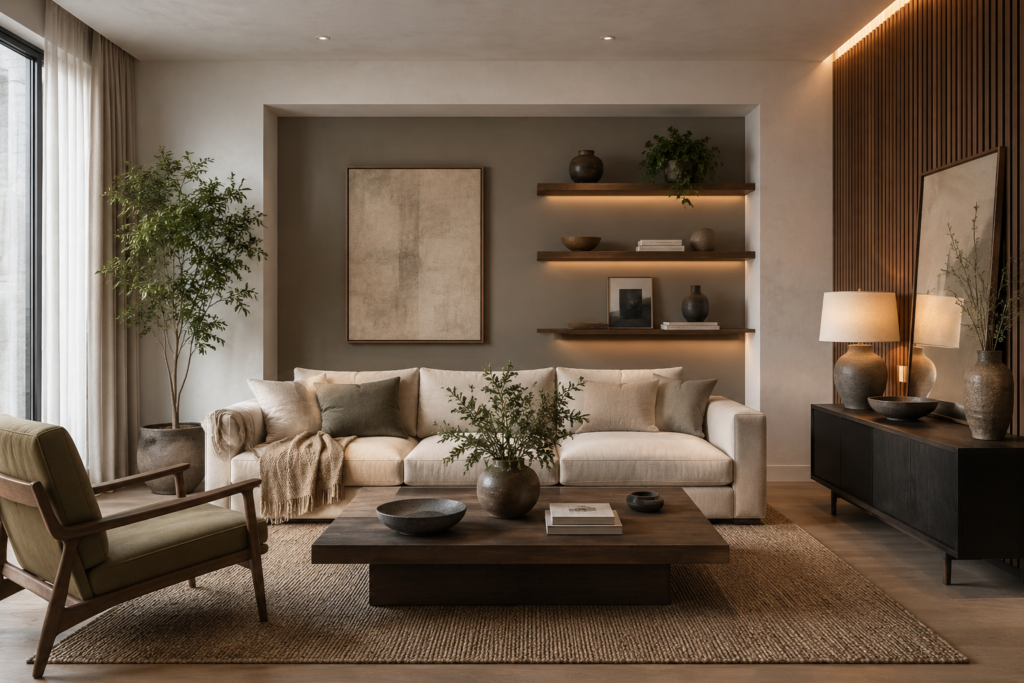
We’ve all had it happen. You step into a room that, on paper, ticks every box – the furniture’s fine, the paint’s fresh, nothing’s actually broken – and still it just sits there. Something’s off. Usually that something is visual depth: the layered quality that makes a space feel rich and lived-in instead of merely furnished.
The good news is you won’t need to take a sledgehammer to anything or drain your savings. A few thoughtful choices can give most plain interiors real dimension and a bit of character. So here’s how to bring an Australian home – or whatever project you’ve got on the go – to life.
Layering Textures and Fabrics
Texture is the easiest place to begin, and it costs a fraction of a renovation. The idea is simple: mix materials that feel different under your hand. A chunky knit throw over smooth leather. Linen cushions next to a velvet armchair. A wool rug beneath your feet. Each contrast catches the eye and, frankly, makes you want to linger.
Walls matter here too. VJ wall panels – the ones with those vertical grooves – cast subtle shadow lines that break up a flat surface. They’ve become a genuine favourite in Australian homes, partly for the classic-meets-coastal look, and they bring architectural interest almost straight away.
Sheen is worth a thought, as well. Set a matte linen beside a glossy silk and the two reflect light differently. Your eye reads that quiet variation as depth, even from across the room.
Strategic Use of Colour and Contrast
Colour shifts how we read a space. A monochromatic palette – different shades of a single hue – brings a layered sophistication without ever tipping into busy. Picture soft greys easing toward charcoal, or warm sandy tones drifting into terracotta.
When you’re after drama, contrast does the heavy lifting. Pair light with dark – a deep navy feature wall behind pale furniture, or black window frames against white – and you build a tension that pulls the eye and gives the room definition. Done well, those high-contrast moments keep a space from looking washed out.
Balance is the thing to watch. Let one approach lead and use the other sparingly, as an accent. That’s roughly the line between cohesive and chaotic.
Incorporating Lighting
Lighting may be the most underrated tool you’ve got. Flat, even light flattens whatever it lands on. Layered light sculpts. Aim for three kinds working together:
- Ambient light for overall brightness
- Task lighting for the spots where you read or cook
- Accent lighting to pick out artwork or a feature you’re fond of
That interplay of light and shadow is really what gives a room dimension. A floor lamp glowing into a corner, a pendant dropping soft pools across the dining table – it’s a richness overhead lighting simply can’t deliver.
Mirrors take it further. Place one well, and it bounces light deeper in while hinting at more space than you’ve actually got. For smaller Australian apartments and tight living areas, that’s a properly useful trick.
Furniture Arrangement and Scale
Where you put your furniture matters more than people tend to assume. Push everything flat against the walls and a room can feel oddly hollow. Pull pieces inward instead. You’ll open up natural pathways and define clear zones – a reading nook over here, somewhere to talk over there.
Scale earns its keep, too. A room of same-height pieces reads as monotonous, so vary it. A tall bookshelf next to a low-slung sofa. A leggy side table beside a solid armchair. Those shifts in height lead the eye up and down, and that movement is what builds the layered, considered feel you’re chasing.
And don’t forget negative space. A little room to breathe between pieces lets each one stand on its own, which adds to the depth as well.
Transforming Your Space
Visual depth isn’t about pricey furniture or sweeping makeovers. It comes down to layering – texture on texture, light against shadow, tall beside low – until a plain room takes on warmth and character.
Start with one approach that suits your space, whether that’s VJ panelling on a feature wall or a rethink of your lighting. Build from there. You’ll be surprised how fast a few small, deliberate changes turn a flat interior into something that feels properly alive.