

Picture a founder attempting to execute a standard board resolution or file an annual report, only to realize their Director Identification Number (DIN) was quietly suspended due to an overdue KYC filing. Until the status is updated, they are completely blocked from submitting any MCA forms—a deeply frustrating yet easily preventable scenario when managing a business.
Acquiring a DIN is an essential prerequisite during private limited company registration, yet most business owners secure it initially and rarely give it another thought until a compliance deadline passes. However, a major regulatory shift in 2026 has updated how directors manage this requirement: DIN KYC has transitioned from a yearly task to a triennial obligation, giving companies and their leadership a fresh perspective on how to structure their long-term compliance schedules.
What Is a Director Identification Number (DIN)?
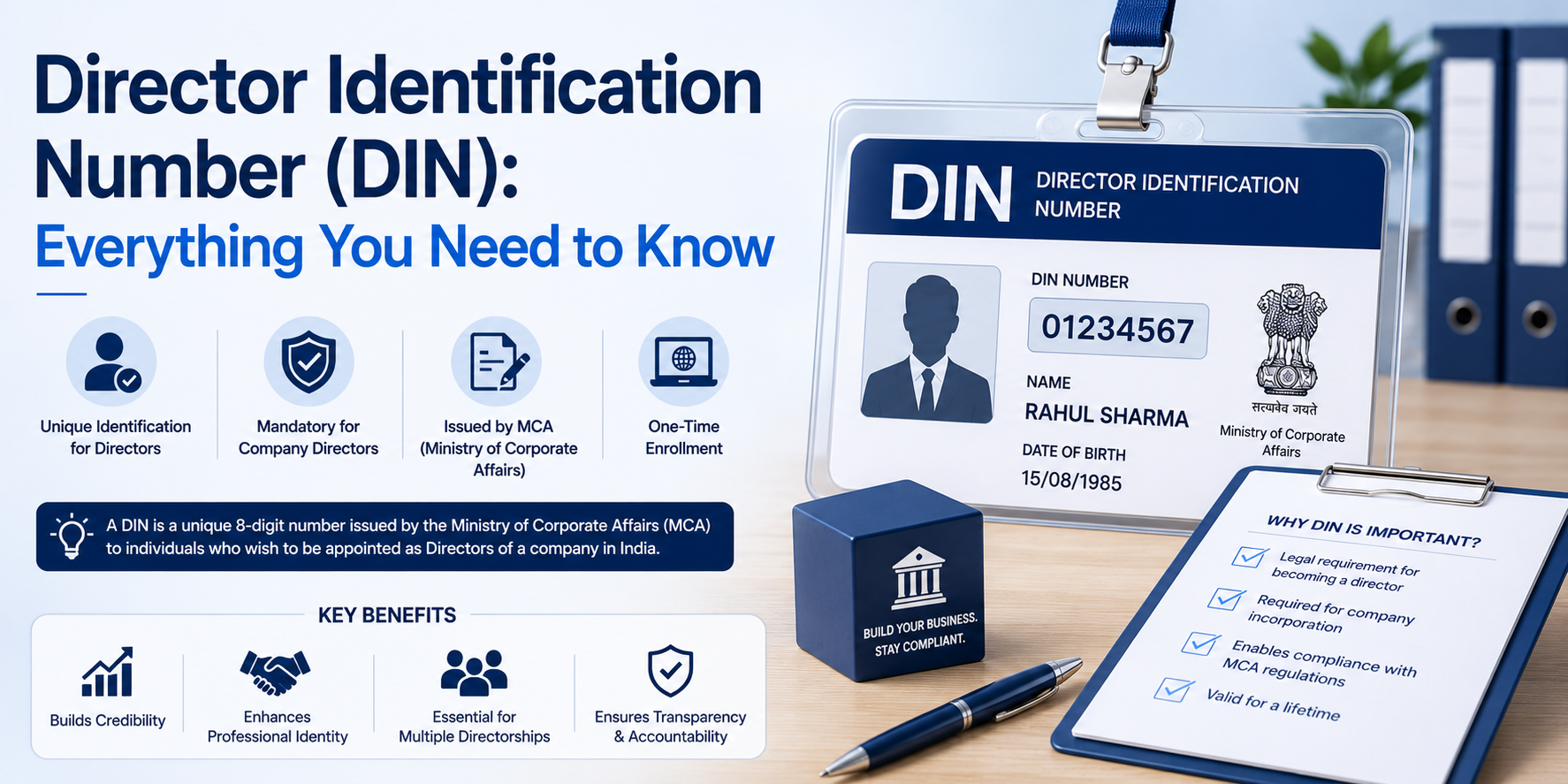
A Director Identification Number (DIN) is a unique identification number allotted by the Ministry of Corporate Affairs (MCA) to any individual who is, or intends to become, a director of a company registered in India. It is an 8-digit number allotted under the Companies Act, 2013 and the Companies (Appointment and Qualification of Directors) Rules, 2014.
Once allotted, a DIN is valid for the director’s lifetime and applies across every company they’re appointed to, a person never needs more than one DIN, no matter how many directorships they hold.
Who Needs a DIN?
A DIN is mandatory for:
- Every individual proposed as a director of a private limited, public limited, or One Person Company (OPC)
- Directors of Section 8 (non-profit) companies
- Designated partners of LLPs (who hold a DIN in place of a DPIN)
- Individuals being appointed as additional or nominee directors on an existing board
How to Apply for a DIN
There are two routes to obtaining a DIN, depending on whether the company is being newly incorporated or already exists.
| Scenario | Route | Form |
| New company incorporation | Apply for DIN directly within the incorporation filing | SPICe+ (Part B) |
| Existing company, new director appointment | Standalone DIN application | Form DIR-3 |
For a new company, up to three proposed directors can apply for DIN simultaneously through SPICe+, using their PAN, Aadhaar (for Indian nationals), or passport (for foreign nationals) as supporting KYC documents. For an existing company appointing an additional director who doesn’t already hold a DIN, Form DIR-3 is filed separately, along with identity proof, address proof, and a photograph, digitally signed and verified by a practicing professional.
Did You Know? A person can hold only one DIN in their lifetime. Applying for a second DIN, even accidentally, is treated as a compliance violation and one of the numbers must be surrendered to the MCA.
What Is DIR-3 KYC?
DIR-3 KYC is a mandatory compliance filing under Rule 12A of the Companies (Appointment and Qualification of Directors) Rules, 2014, that requires every DIN holder to verify their personal details, including PAN, mobile number, email address, and residential address, with the MCA. It confirms and updates a director’s KYC particulars with the Central Government and keeps the DIN in “Active” status.
Filing applies to every DIN holder, regardless of whether they are currently serving as a director. This includes active directors of public, private, OPC, and Section 8 companies, as well as directors who have resigned but still hold a valid DIN.
Major 2026 Update: DIN KYC Is Now Triennial, Not Annual
Until the 2025 financial year, DIR-3 KYC was filed every single year, regardless of whether any personal details had changed. Through the Companies (Appointment and Qualification of Directors) Amendment Rules, effective from April 1, 2026, this has changed: DIR-3 KYC now applies once every three consecutive financial years instead of annually, meaningfully reducing the recurring compliance burden on directors.
Effective 31 March 2026, a single unified Form DIR-3 KYC Web now replaces both the earlier e-form and web-service versions that directors previously had to choose between.
Important: If a director’s mobile number, email, or residential address changes during the three-year cycle, they must still submit Form DIR-3 KYC Web within 30 days of the change, rather than waiting for the next triennial cycle.
Revised DIR-3 KYC Fee Structure (2026)
The Companies (Registration Offices and Fees) Amendment Rules, 2026, notified on 21 April 2026, introduced a revised fee structure for DIR-3 KYC filing:
| Filing Scenario | Fee |
| Filed within the prescribed triennial timeline | Nil |
| Filed after the due date, or to reactivate a deactivated DIN | ₹5,000 |
| Filed again during the cycle due to a change in personal details | ₹500 per filing |
The ₹5,000 penalty is mandatory and non-discretionary, applying even where the delay was unintentional, or resulted from a change in employment, resignation, or an inactive directorship.
What Happens If DIR-3 KYC Isn’t Filed on Time?
Consequence: Immediate DIN deactivation. Failure to comply with the DIR-3 KYC filing requirement results in immediate deactivation of the DIN under Rule 11(2) of the Companies (Appointment and Qualification of Directors) Rules, 2014.
Once deactivated, a director cannot:
- Sign or file any MCA forms
- Be appointed as a director of a new company
- Continue functioning as an authorised signatory on pending filings
Reactivation is possible only by filing the KYC form along with the ₹5,000 penalty payment, there’s no separate “reactivation form”; the same DIR-3 KYC Web filing restores active status once the fee is paid.
Compliance Checklist for Directors
- Confirm your DIN’s current status (Active or Deactivated) on the MCA portal
- File DIR-3 KYC Web within your applicable triennial cycle
- Update mobile number, email, or address within 30 days of any change
- Keep PAN, Aadhaar, and passport details consistent across MCA records
- Verify KYC compliance before accepting a new directorship appointment
- Never apply for a second DIN under any circumstance
Common Mistakes Directors Make
- Assuming resignation ends the KYC obligation, a resigned director must still file KYC as long as the DIN remains valid
- Missing the 30-day window for updating changed contact details, resulting in a fresh ₹500 fee
- Applying for a new DIN when appointed to a different company, instead of reusing the existing one
- Ignoring deactivation notices, which blocks the director from signing any further MCA filings until resolved
Case Study: A director who stepped down from a startup’s board in 2024 assumed her compliance obligations ended with resignation. Two years later, she was appointed to a new company’s board, only to discover her DIN had been deactivated for missed KYC filings during the gap. She had to pay the ₹5,000 reactivation fee and file fresh KYC before the new company’s incorporation could even be completed, delaying the process by nearly a week.
Quote: “A DIN doesn’t expire when you leave a boardroom, it follows you until you formally close the loop with the MCA.”
Latest News: With the shift to triennial filing, several compliance advisories are urging directors to set calendar reminders well in advance of their specific three-year window, since the change is recent enough that many directors may still expect an annual deadline and inadvertently miss the new one.
changed, it’s worth having a professional confirm your specific filing cycle and deadline rather than relying on the old annual assumption.
Why Choose Zolvit?
- Expert lawyers and Company Secretaries who track your DIN KYC deadlines proactively
- Dedicated CA support for DIN applications, both via SPICe+ and standalone DIR-3
- Fast processing of KYC filings and DIN reactivation
- Affordable, transparent pricing with no hidden charges
- End-to-end compliance, from first DIN allotment to every subsequent filing
- Dedicated support so you never face a deactivated DIN unexpectedly
CTA: Not sure when your next DIR-3 KYC filing is due?
Talk to a Zolvit’s expert for a free DIN compliance check and hassle-free filing.
Key Takeaways
- A DIN is a lifetime, unique 8-digit number allotted to every company director in India.
- It’s obtained via SPICe+ for new companies or Form DIR-3 for existing ones.
- DIR-3 KYC verifies a director’s details and keeps the DIN active.
- As of 2026, KYC filing is triennial, not annual, reducing recurring compliance work.
- Filing within the deadline is free; late filing or reactivation costs ₹5,000.
- A deactivated DIN blocks all MCA filings until KYC is completed and the penalty is paid.
Conclusion
A Director Identification Number is a lifetime credential, but staying compliant with it isn’t a one-time task, it requires ongoing attention, especially with the 2026 shift to a triennial KYC cycle and the accompanying fee changes. Whether you’re applying for a fresh DIN through SPICe+, appointing a new director via Form DIR-3, or simply tracking your own KYC deadline, missing a filing can freeze your ability to act as a director at the worst possible moment. Given how recently these rules