

Enterprise networks tend to grow by accumulation. A new branch office calls for another appliance, a new compliance requirement adds another inspection tool, and a move to the cloud introduces yet another layer of controls that has to coexist with everything already in place. Each addition makes sense on its own, but over years the combined result is an architecture so layered and interdependent that no single person fully understands it. Complexity, not any individual threat, becomes the quiet liability that slows every project and hides every gap.
Simplification has therefore become a goal in its own right. The appeal of bringing networking and security together into a single cloud-delivered framework is not only better protection but also a dramatically clearer picture of how traffic moves and is controlled. When the architecture stops fighting itself, teams spend less time managing the plumbing and more on the work that matters.
Organizations rethinking a tangled estate can begin by examining unified SASE for enterprise security to understand how consolidating connectivity and protection into a single framework reshapes the underlying architecture rather than simply adding to it.
The Cost of an Overgrown Architecture
The expense of a sprawling network rarely shows up as a single line item. It surfaces instead as friction. Every appliance in the chain is one more device to configure, patch, monitor, and eventually replace. Every vendor relationship is one more contract, one more support process, and one more console with its own logic. When traffic has to traverse a long series of separate boxes, each hop adds latency and another opportunity for a misconfiguration to break something or let something through.
This accumulation also makes change expensive. Adding a location or onboarding a group of remote workers can mean touching half a dozen systems, each with its own quirks. The architecture becomes brittle, and brittleness breeds caution, which is why so many overdue improvements sit untouched. The real cost is not just the hardware but the organizational inertia that complexity creates.
Collapsing the Stack Into One Plane
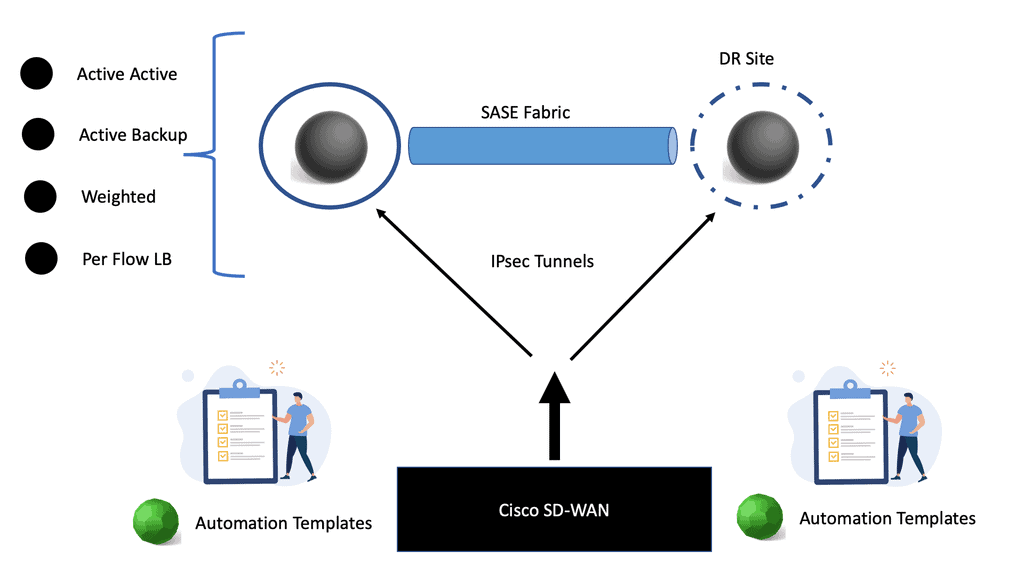
A unified, cloud-delivered model attacks this problem at its root by collapsing many separate functions into a single service plane. Instead of routing traffic through a chain of distinct appliances, the architecture sends it to a nearby point of presence where connectivity and the full set of protective functions are applied together. The long, fragile service chain gives way to a single, consistent step.
The effect on the diagram is striking. Where there were once many boxes connected by many links, there is now one framework that handles the same work. Policy is defined once and applied everywhere, so the rules that govern a remote user match those that govern a branch office without anyone having to translate between systems. That single source of truth is what makes the architecture comprehensible again, and a comprehensible architecture is one a team can actually defend.
Fewer Moving Parts, Fewer Failure Points
Simplicity is not only an aesthetic preference. Every component removed from the path is a component that can no longer fail, be misconfigured, or fall behind on updates. Consolidating functions into one resilient, cloud-delivered service reduces the number of independent things that must all work correctly for the network to stay both available and protected.
This matters for continuity as much as for security. An architecture with fewer single points of failure is easier to keep running through disruptions and easier to restore when something does go wrong. Organizations that formalize this thinking often align their planning with a recognized model, and a continuity standard reference on building resilient operations can help teams reason about how a simpler design supports recovery objectives rather than working against them.
Simpler Operations, Clearer Accountability
When connectivity and protection live in one framework, the daily experience of running the network changes. A single console replaces the scattered dashboards that each told part of the story. One stream of telemetry shows how traffic actually behaves, so troubleshooting means following a clear path rather than correlating logs from systems never designed to talk to one another.
Accountability sharpens as well. In a fragmented architecture, responsibility for a problem can fall into the seams between teams that each own a different appliance. A unified model dissolves many of those seams, giving a clearer view of who owns what and reducing the finger-pointing that complexity tends to encourage. The organization gains not just a simpler network but a simpler way of working.
Architecture as a Risk Decision
Choices about network architecture are ultimately choices about risk. A design that no one fully understands carries hidden exposure, because gaps tend to hide in the parts of a system that escape attention. Simplifying the architecture is, in this sense, a way of shrinking the space where unknown risks can accumulate.
Framing the decision in those terms helps it earn the attention it deserves at the leadership level. Consulting a risk management overview on how organizations structure and monitor their exposure can ground an architecture conversation in the language executives and auditors already use, making it easier to justify consolidation as a deliberate reduction of risk rather than a purely technical preference.
A Phased Path to a Simpler Network
Reaching a simpler architecture is itself a project that benefits from restraint. Few organizations can replace everything at once, and trying to would introduce exactly the kind of risk that simplification is meant to reduce. A measured path typically starts by routing remote user traffic through the unified framework, then adds branch connectivity, and finally brings data center and cloud paths under the same umbrella.
Each stage retires some of the old complexity and proves the model before the next step. Mapping the existing architecture honestly before beginning is essential, since it reveals the redundant controls and forgotten rules that consolidation can finally clear away. Done patiently, the result is a network that does more while containing far less.
Conclusion
The case for a unified, cloud-delivered approach is often made in terms of security, but its quieter benefit is architectural clarity. By collapsing a sprawling chain of appliances into a single framework, it removes the complexity that has quietly taxed enterprise networks for years. Fewer parts mean fewer failures, simpler operations, clearer accountability, and a smaller space for hidden risk. For organizations buried under their own accumulated infrastructure, simplification is less a cosmetic upgrade than a way to make the network understandable and defensible.
Frequently Asked Questions
Does simplifying network architecture mean sacrificing capability?
No, the goal is to deliver the same functions through fewer components. Consolidation removes redundancy rather than protection. In most cases capability improves because policy becomes consistent everywhere.
How does a unified framework reduce operational workload?
It replaces many consoles and update cycles with a single point of management. Teams troubleshoot from one stream of telemetry instead of many. That consolidation frees time once lost to maintaining disconnected tools.
Is it risky to move to a consolidated architecture all at once?
A phased rollout is usually safer than a single cutover. Most organizations migrate remote access first, then branches, then core paths. Each stage proves the model before the next begins.
