

AI coding assistants have made the first implementation dramatically faster.
A developer can describe an API endpoint, parser, database query or utility function and move from requirement to working code in minutes.
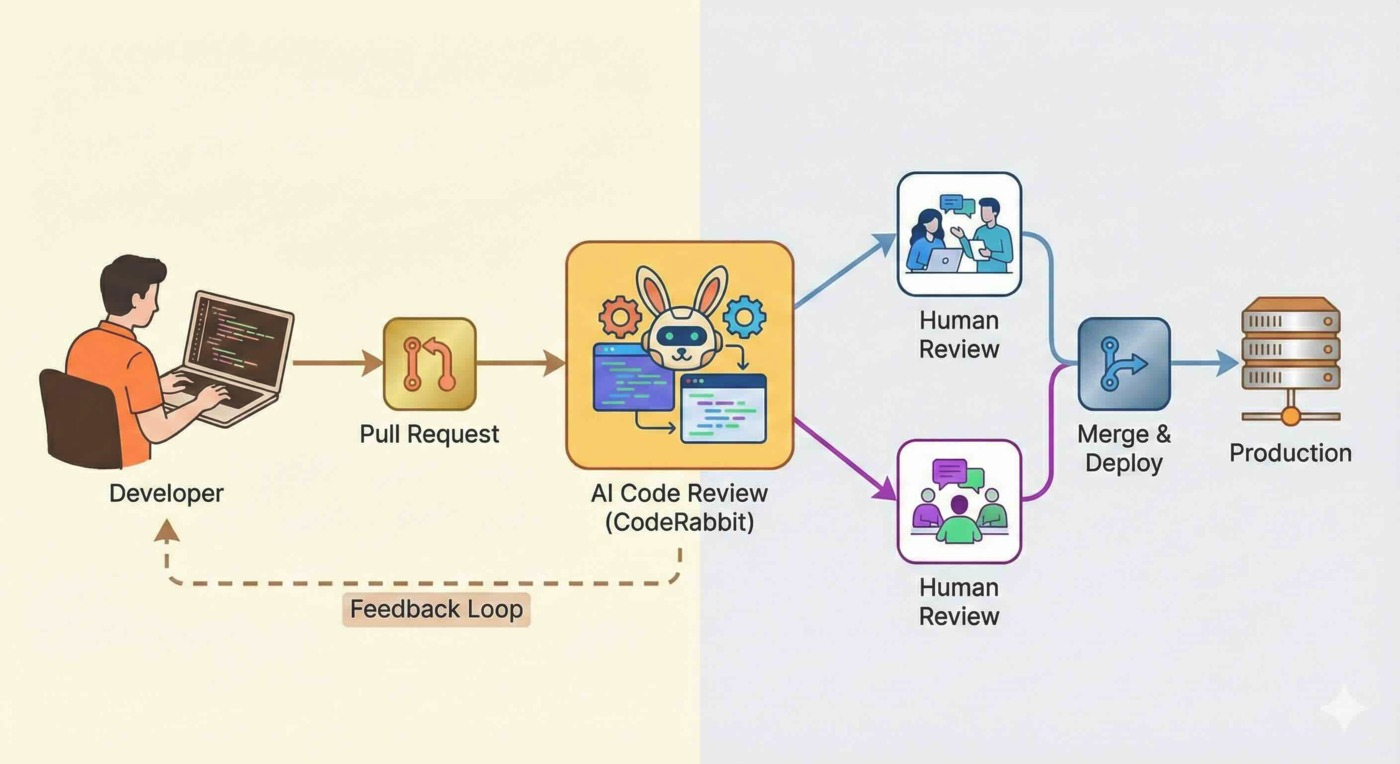
That speed creates another opportunity: use AI not only to write the code, but also to review it before the pull request reaches the rest of the team.
With access to multiple models, developers can give different systems different review responsibilities. One model can focus on implementation, another on input handling, another on authorization or data flow, and another on tests.
The result is not a replacement for the existing development pipeline.
It is an additional review layer that can happen earlier, while the developer is still actively working on the feature.
Code Review Can Start Before the Pull Request
Traditional code review often begins after implementation.
The developer finishes the feature, runs tests, opens a pull request and waits for another engineer to inspect the change.
AI makes it practical to introduce a review pass earlier.
A simple workflow can look like this:
- Generate or write the implementation.
- Ask another model to review one specific aspect.
- Improve the code while the task is still fresh.
- Run tests and automated checks.
- Open the pull request with a more mature first version.
This changes the role of AI.
Instead of only accelerating code generation, it can help developers prepare code for the human review that follows.
Different Models Can Take Different Review Roles
Multi-model coding becomes much more useful when every model is not asked to generate the same solution.
Consider a new API endpoint.
One model might be used for the implementation:
Build this endpoint according to the project requirements.
A second can focus on data handling:
Review how external inputs are validated and normalized.
A third can look at application rules:
Check whether the access logic is consistent with these authorization requirements.
A fourth can work on tests:
Suggest additional scenarios that would strengthen coverage.
Each model approaches the same implementation from a different direction.
That produces more useful information than four nearly identical code blocks.
The Same Prompt Can Reveal Different Developer Strengths
A practical comparison shared in Use AI reviews shows why this approach can work.
The same Python prompt was sent through eight AI models.
The task involved:
- nested JSON;
- inconsistent field names;
- missing values;
- normalization;
- test generation.
Because the task remained the same, it became easy to see how differently the models approached it.
Some responses emphasized concise implementation.
Others provided more detailed reasoning.
Some surfaced additional edge cases.
Others contributed stronger test ideas or asked useful questions about ambiguous requirements.
For a developer, those differences are useful because code review itself benefits from multiple perspectives.
The objective does not have to be deciding which model is universally best.
It can simply be choosing the most useful perspective for the stage of work.
Start With Input Handling
Input handling is a natural candidate for an AI-assisted review pass.
Suppose an application receives:
{
“user”: {
“name”: “Alex”,
“email”: “[email protected]”
}
}
The implementation may already work for the expected structure.
A review model can then help generate additional scenarios:
- user is absent;
- email is optional;
- a nested object is empty;
- an additional field appears;
- a value arrives under an accepted alternative name;
- the data type differs from the common case.
The purpose is not to search for failure for its own sake.
It is to make the expected behavior more explicit.
That can improve both implementation and tests before the pull request is opened.
Use AI to Clarify Data Contracts
Many development questions are really contract questions.
Imagine a requirement that says:
Handle missing fields gracefully.
The implementation still needs a concrete policy.
Should an optional field:
- become None;
- be omitted;
- use a default value?
What about a required identifier?
Different answers may all make sense in different systems.
AI can help developers turn a broad requirement into a clearer contract.
For example:
List the data-handling decisions this implementation needs to define before it is finalized.
That can produce a useful checklist without requiring the model to change any code.
Authorization Can Be Reviewed Against Explicit Rules
The same approach works for access control.
Suppose an endpoint retrieves an invoice by ID.
Instead of asking a model broadly whether the endpoint is “secure,” provide the actual business rules:
- customers can access their own invoices;
- organization administrators can access invoices for their organization;
- support users have read-only access under defined conditions.
Then ask:
Review this implementation against these authorization rules and show which rule is enforced where.
This is much more useful than a generic security prompt.
The model has a defined standard to evaluate.
The developer can then compare that review with the implementation before handing the code to another engineer.
SQL Review Can Focus on Engineering Standards
Database code is another good candidate for a targeted review.
A model can be asked to check:
- whether parameters are handled consistently;
- whether the query returns only required fields;
- whether transaction behavior matches the operation;
- whether the query follows repository patterns;
- whether an existing helper or ORM convention should be used;
- whether the operation is likely to scale appropriately.
This makes AI useful as a second engineering perspective.
It can also help explain the query to a developer who is less familiar with that part of the stack.
Ask One Model to Explain Another Model’s Code
A surprisingly useful workflow is separating implementation from explanation.
Model A writes the function.
Model B receives the final version and gets a different instruction:
Explain the important implementation decisions and identify anything a reviewer should pay attention to.
This can produce a concise review guide.
For a pull request, that might surface:
- new validation behavior;
- assumptions about optional values;
- changes in database access;
- new dependencies;
- changes to an API response;
- added test scenarios.
The developer can use that output to improve the PR description as well as the code.
Structured Review Prompts Work Better Than “Review This”
Broad review prompts tend to produce broad answers.
A stronger workflow gives each pass a specific purpose.
Input review
Check how external inputs are validated, normalized and passed through the application.
Authorization review
Compare this implementation with the access rules below.
Data review
Identify where sensitive or internal fields are read, returned or logged.
Dependency review
Explain what each newly introduced dependency contributes and whether the repository already has an equivalent.
Testing review
Suggest additional scenarios based on the behavior implemented here.
These prompts make the review easier to evaluate because the developer knows what the model was asked to inspect.
File Handling Benefits From the Same Approach
File-processing code often includes more decisions than the core upload or parsing logic suggests.
A review can look at:
- accepted file types;
- file-size rules;
- generated filenames;
- storage location;
- cleanup behavior;
- metadata;
- access rules.
Again, the goal is to turn project expectations into explicit engineering checks.
AI can help make the checklist comprehensive before the feature enters the normal review process.
Review Dependencies in Context
AI coding tools can quickly propose libraries and packages.
That is useful when the developer is exploring implementation options.
A second-model review can ask a more contextual question:
Compare this dependency with the packages already used in the repository. What does it add, and could the same result be achieved using the existing stack?
That gives the team more information before adding another dependency.
The model can also help summarize:
- the role of the package;
- where it is used;
- which project problem it solves;
- what configuration it requires.
This turns dependency selection into a documented engineering decision.
One Model Can Generate Tests, Another Can Expand Them
Testing is another place where model diversity can be productive.
Model A may generate the implementation and an initial test suite.
Model B can then receive only the final code and tests:
Suggest additional test scenarios without rewriting the implementation.
A third model can focus on boundary conditions.
This reduces the chance that the test suite simply mirrors the assumptions of the model that wrote the function.
More importantly, it gives the developer a larger pool of test ideas to choose from.
Multi-Model Platforms Make These Handoffs Easier
This workflow becomes easier when developers can move between models without treating each one as a separate destination.
Use AI provides access to multiple AI model families in one environment, including Claude, ChatGPT, Gemini, Grok, DeepSeek, Kimi and GLM, with the ability to switch models within an active conversation.
For coding work, that enables a simple pattern:
implementation → second opinion → focused review → refinement
without rebuilding the entire technical context for every stage.
Projects, knowledge bases and files can also provide supporting context for longer-running development work.
The practical benefit is not using as many models as possible.
It is being able to bring in another perspective exactly when it is useful.
Keep the Project Standard Consistent Across Models
A multi-model workflow works best when every model reviews against the same project requirements.
Useful shared context might include:
- coding standards;
- architecture notes;
- authorization rules;
- API contracts;
- dependency guidelines;
- examples of accepted implementations;
- testing conventions.
Then each model contributes within the same engineering framework.
The implementation model and the review model may approach the code differently, but both are working toward the same standard.
Deeper Reasoning Can Be Reserved for Harder Reviews
Not every review task needs the same level of analysis.
Some questions are straightforward:
Does this function follow the expected response schema?
Others involve more context:
Trace how this permission is enforced across the API layer, service layer and database query.
Current AI platforms increasingly allow developers to choose different reasoning levels depending on the complexity of the task.
Use AI includes adjustable reasoning options for supported models, which makes it possible to use faster interaction for routine work and deeper analysis for more involved review tasks.
That can make code review more efficient rather than simply more extensive.
AI Can Help Prepare Better Pull Requests
The output of these review passes does not have to remain inside the AI chat.
After the implementation is finalized, a model can help generate a useful pull request summary.
For example:
Summarize what changed, the main implementation decisions, tests added and areas reviewers should examine. Use only information reflected in the final code.
That can produce a PR description containing:
- purpose of the change;
- key implementation decisions;
- relevant data-handling behavior;
- test coverage;
- dependencies introduced;
- specific review notes.
A clearer PR can make the human review faster as well.
AI Review Complements Existing Development Tools
AI-assisted review fits naturally alongside the tools development teams already use.
A modern workflow may include:
- unit tests;
- integration tests;
- static analysis;
- linters;
- dependency checks;
- CI;
- human code review.
AI adds another type of feedback.
Traditional tools are excellent at checking predefined rules and executable behavior.
AI can help reason about:
- requirements;
- assumptions;
- alternative implementations;
- code explanations;
- review questions.
Those capabilities complement each other.
Earlier Feedback Is Easier to Use
The timing is one of the biggest advantages.
If a developer asks for a second-model review immediately after writing the implementation, the task is still fresh.
The developer remembers:
- why a particular approach was chosen;
- which requirements were ambiguous;
- what alternatives were considered;
- where the tricky parts are.
Feedback at that stage is easy to act on.
A practical workflow might be:
- Create the implementation.
- Run one or two focused AI review passes.
- Improve the code and tests.
- Run the project’s normal automated checks.
- Prepare the pull request.
- Continue with human review.
AI is helping strengthen the first version that reaches the team.
Build a Small Review Prompt Library
Teams that use AI coding regularly can make the process repeatable.
A lightweight prompt library might contain:
API review
Compare this endpoint against the API contract and identify any behavior that should be clarified.
Input review
Review how this implementation handles each expected input form.
Access review
Map the provided authorization rules to the relevant code paths.
Database review
Review this query for consistency with the repository’s existing database patterns.
Test review
Suggest additional scenarios that would meaningfully extend the current tests.
PR review
Summarize the change as if you were preparing another developer to review it.
These prompts can be reused across models and projects.
Different Perspectives Are the Main Advantage
The most interesting lesson from comparing AI models on the same coding task is not that one answer must always win.
It is that different models can emphasize different parts of the problem.
One may explain the reasoning especially well.
Another may produce a concise implementation.
Another may contribute useful test scenarios.
Another may surface a requirement worth clarifying.
That variation becomes valuable when developers assign each model a focused role.
The question changes from:
Which AI writes the best code?
to:
Which perspective would improve this code before another developer sees it?
Better First Reviews Can Make the Whole Workflow Faster
AI coding started with generation.
Code review is a natural next step.
The same tools that help developers create an implementation can also help them:
- examine it from another perspective;
- clarify requirements;
- expand test scenarios;
- check project conventions;
- explain technical decisions;
- prepare a stronger pull request.
Multi-model access makes that workflow especially flexible because developers do not need one model to be equally strong at every stage.
One model can build.
Another can review.
Another can explain.
The developer remains responsible for the final engineering decision, while AI helps bring more useful feedback earlier in the process.
That is a much broader productivity gain than simply generating code faster.
