

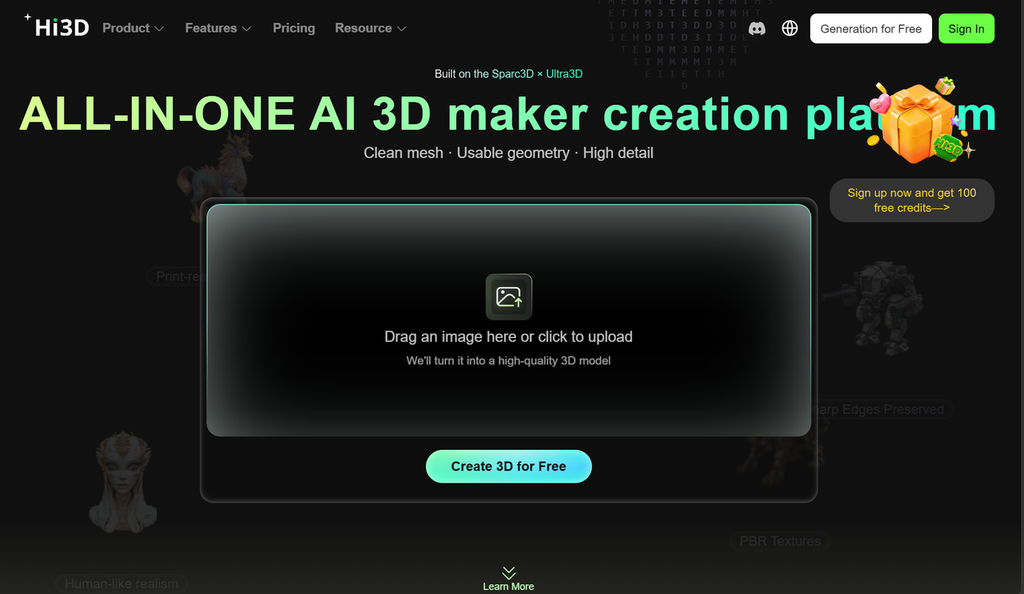
The growth of AI and 3D printing is changing the way people create, design, and produce objects. Today, creators are no longer limited to traditional manufacturing methods. From personalized products and collectible figures to prototypes and creative projects, 3D printing is becoming a more accessible tool for turning digital ideas into physical results.
However, creating a high-quality 3D model is still not simple for many users. Designers often need to spend time converting concepts into models, improving details, adjusting textures, and preparing files for production.
Hi3D is built to simplify this entire creative process. By combining AI generation technology with practical 3D workflows, Hi3D helps users transform images, text descriptions, and creative concepts into usable 3D assets. With the launch of Hi3D V3.0, the platform further improves AI 3D creation by focusing on higher model accuracy, better texture quality, and stronger production capabilities.
For designers and creators, Hi3D V3.0 represents a new approach to 3D creation. It is not only about generating models faster, but also about making those models more suitable for real creative and production scenarios.
1. The Challenges Designers Face in Modern 3D Creation
Although AI has lowered the barrier to digital creation, designers still face several challenges when working with 3D content. A successful 3D asset needs to maintain the original creative intention while also meeting technical requirements.
For many creators, the process between having an idea and obtaining a usable 3D model remains complicated.
1.1 Turning creative concepts into complete 3D models
Designers often begin with sketches, illustrations, product ideas, or visual references. However, transforming these concepts into complete 3D models traditionally requires professional modeling skills and significant time.
This creates a gap between creativity and execution. Many users have strong ideas but cannot quickly transform them into 3D assets.
Hi3D helps reduce this barrier by allowing users to create models from images and text. As an AI 3D model maker, Hi3D provides a simpler way for creators to explore 3D ideas without relying entirely on traditional modeling workflows.
1.2 Reducing repeated manual adjustments
Even after an AI-generated model is created, designers may still need to fix structural issues, improve details, and prepare the model for further use.
A model that only looks good from one angle may not be enough for real applications. It needs stable geometry, complete structures, and detailed surfaces.
Hi3D V3.0 focuses on improving these areas by enhancing the quality and usability of AI-generated models, helping creators spend less time on corrections and more time on creative development.
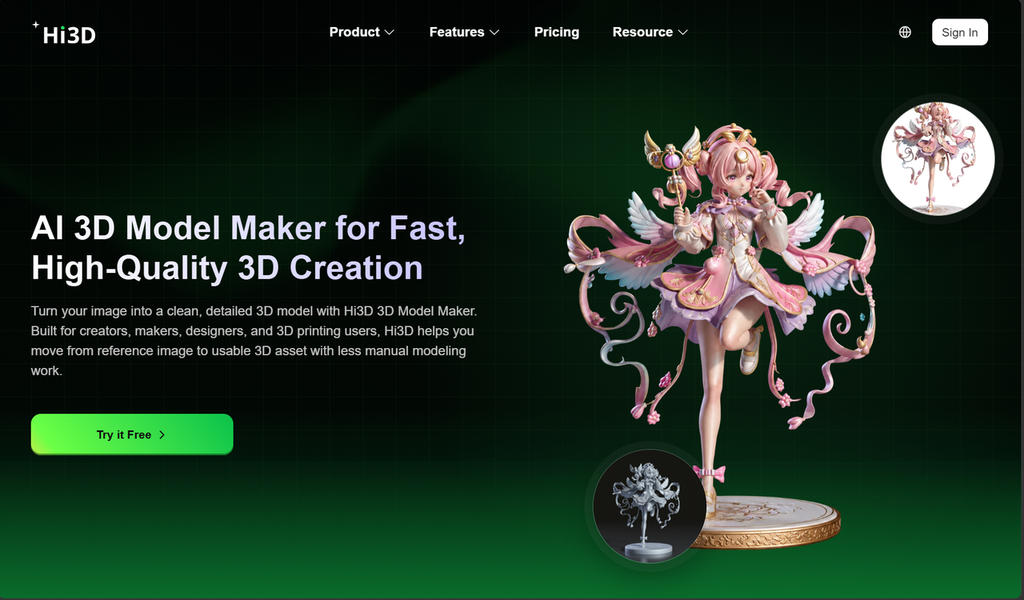
2. From Images and Text to 3D Models: Making Digital Creation More Flexible
One of the most important advantages of AI 3D technology is the ability to transform simple creative inputs into complete three-dimensional assets.
Instead of starting with complicated modeling software, users can begin with images or descriptions and let AI assist in the creation process.
2.1 Creating 3D models from visual references
Many design projects start with a two-dimensional reference. It could be a character design, product image, artwork, or personal creative concept.
In traditional workflows, converting these images into 3D models requires manual reconstruction. Designers need to understand modeling techniques and spend time rebuilding structures.
Hi3D simplifies this process by allowing users to generate 3D models from images. This capability, known as 2D image to 3D model, helps transform flat visual ideas into three-dimensional assets.
For example, a designer can upload a concept image, generate an initial model, improve the texture, and prepare it for visualization or printing.
This approach is especially useful for creators who want to quickly test different ideas or develop multiple design directions.
2.2 Creating models from text descriptions
Images are not always available at the beginning of a project. Sometimes a creator only has a concept or description.
Hi3D supports text-based 3D generation, allowing users to describe objects, characters, or creative ideas and transform them into digital models.
This makes the creative process more flexible because users can start directly from imagination rather than existing visual materials.
For independent creators, educators, and designers, this provides a more natural way to explore 3D creation.
2.3 Improving model details with Hi3D V3.0
The quality of generated models determines whether they can be used beyond simple previews. Hi3D V3.0 introduces major improvements in AI 3D generation quality.
The new version increases geometric reconstruction resolution to 2048³ voxel-level and becomes the first commercially available AI 3D model with this level of resolution. It also improves cross-view structural reasoning and introduces an upgraded UV completion algorithm.
With stronger geometric representation, details that were previously difficult to preserve can now be reconstructed more accurately. Small structures, surface changes, thin parts, and complex connections can achieve better results.
For designers, this means AI-generated models can better maintain the original creative concept.
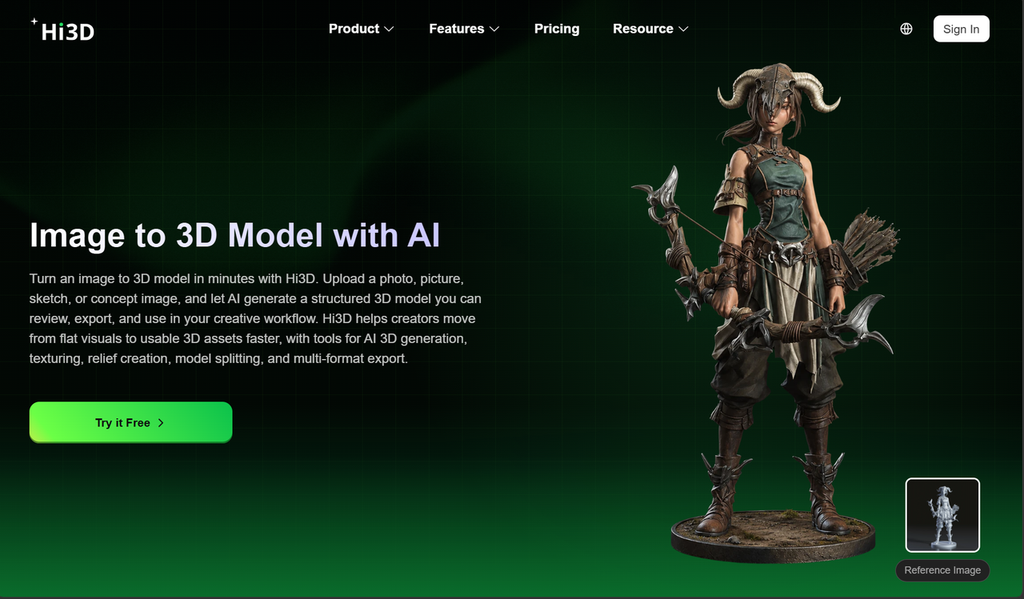
3. AI Texture Generation: Improving Visual Quality and Design Expression
A model’s appearance depends heavily on its surface details. Textures define materials, colors, patterns, and overall visual identity.
For designers, creating high-quality textures is often another challenge after modeling. Manual texturing requires additional skills and can take a significant amount of time.
Hi3D provides AI-powered texture generation to help users create more complete and visually detailed models.
3.1 Simplifying texture creation for designers
Traditional texturing workflows often require specialized software and experience. Designers need to manage UV mapping, materials, and surface details manually.
Hi3D reduces this complexity by using AI assistance to generate and improve textures. Users can focus on creative decisions while AI helps enhance the visual quality of the model.
This capability can be described as an AI texturing solution, helping creators produce detailed models more efficiently.
3.2 Enhancing texture quality with V3.0 technology
Hi3D V3.0 significantly improves texture generation capabilities. The new version increases texture output to a maximum of 8K and upgrades the self-developed UV completion algorithm.
These improvements enhance pattern clarity, color transitions, and detailed texture recognition when models are viewed at larger scales.
For product designers, digital artists, and creators working on collectibles, higher-quality textures provide more opportunities to achieve professional visual results.
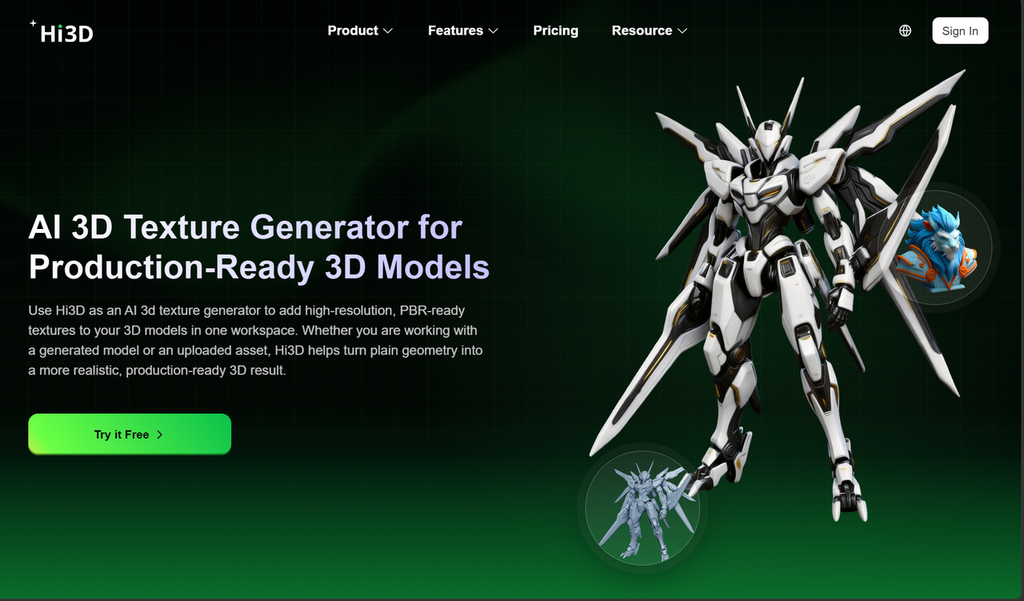
4. Additional Features Supporting the Complete 3D Production Process
Creating a detailed model is only the beginning of a complete 3D workflow. To help users move from digital creation toward physical production, Hi3D V3.0 also introduces additional features for printing preparation.
4.1 Multi-color printing for more detailed physical models
Many AI-generated models contain complex visual information, but reproducing these details through printing can be challenging.
Hi3D’s multi-color printing feature helps transform textured models into printable multi-color objects by generating color regions, matching filament colors, and reducing manual color adjustments.
This helps creators achieve physical results that are closer to their original designs.
4.2 Split-for-printing and smart arrangement
For larger models or character designs, printing the complete object as one piece may not always be practical.
Hi3D provides split-for-printing functions that separate models into printable parts and generate connectors for easier assembly.
The smart arrangement feature helps users prepare models before printing by suggesting better orientations, arranging parts on the build plate, and exporting 3MF files with recommended slicer settings.
These tools help create a smoother connection between AI-generated models and real printing workflows.
5. Hi3D V3.0 Official Release: A New Generation of AI 3D Creation
The official release of Hi3D V3.0 marks an important step in the development of AI-powered 3D creation. Instead of focusing only on generating models quickly, the new version focuses on improving whether these models can support real creative and production needs.
For designers, this means AI becomes more than a concept-generation tool. It becomes a complete assistant that helps transform ideas into usable 3D assets.
5.1 The evolution from model generation to production-ready creation
Hi3D has developed through several major versions, with each generation improving different parts of the AI 3D workflow.
Hi3D V1.0 introduced a commercially available 1536³ voxel-resolution image-to-3D model, improving detailed structure reconstruction.
Hi3D V2.0 focused on integrated geometry and texture generation, improving structural completion and creating a more complete workflow.
Hi3D V3.0 continues this evolution by improving geometric precision, complex structure reasoning, texture quality, and production-related features including smart splitting, multi-color printing, and arrangement tools.
The development path shows a clear transition from simply generating models to creating assets that can better support real applications.
5.2 Three major improvements bringing AI 3D closer to real use
The first major upgrade is higher geometric accuracy. By increasing reconstruction resolution to 2048³ voxel-level, Hi3D V3.0 preserves more information during model creation and improves the representation of detailed structures.
The second improvement is stronger structural stability. Since a single image only shows part of an object, AI needs to understand hidden areas and relationships. Hi3D V3.0 improves cross-view reasoning, helping generated models remain more consistent from different angles.
The third improvement is upgraded texture quality. With up to 8K texture output and improved UV completion technology, Hi3D V3.0 provides richer and clearer surface details.
Together, these upgrades help reduce the distance between AI-generated concepts and usable 3D assets.
6. Expanding applications across creative industries
High-quality 3D assets are becoming increasingly important across industries including 3D printing, digital art, game and film production, jewelry design, collectibles, education, e-commerce content, and industrial design.
Although these fields have different needs, they all require models with accurate geometry, stable structures, clear textures, and practical usability.
Hi3D V3.0 aims to lower the difficulty of creating professional-quality 3D content and help more creators participate in AI-powered 3D production.
6.1 Experience Hi3D V3.0 with a 48-hour free trial
The future of AI 3D creation is moving toward a complete connection between imagination, digital design, and physical production.
With improved generation accuracy, upgraded texture capabilities, and stronger production tools, Hi3D V3.0 provides creators with a more efficient way to develop high-quality 3D assets.
Hi3D V3.0 is officially released, and users can experience the latest version through a 48-hour free trial. During the trial period, users can use Hi3D V3.0 without limits on generation times and explore its upgraded capabilities.
Start creating with Hi3D V3.0 and discover how AI can help transform your creative concepts into detailed, practical, and production-ready 3D models.
