

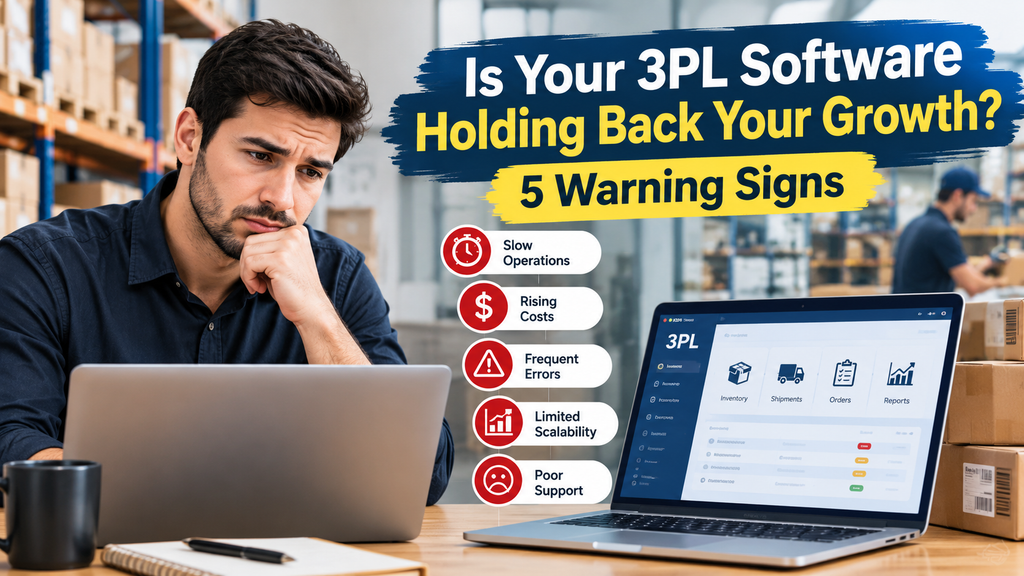
Your ops team is hitting SLAs. Shipments are going out. Customers aren’t complaining — at least not yet. By every operational metric your team tracks, the software running your fulfillment operation appears to be doing its job.
But your margins are quietly shrinking.
This is the most dangerous growth trap in modern fulfillment: the period between when your 3PL warehouse management software starts failing your business and when your operations team actually feels it. That gap — frequently 60 to 90 days wide — is where P&L damage compounds invisibly. The five warning signs covered here don’t show up in exception reports or your WISMO ticket queue. They show up in your numbers first. If you know where to look, your finance team has already been trying to tell you something your ops dashboard never will.
The Operational Blindspot Costing You More Than Chargebacks
Operators are conditioned to manage fulfillment by exception. Late shipment rate spikes, a surge in customer complaints, an inventory discrepancy that triggers a recount — these are the signals that mobilize action. Every one of them is a lagging indicator. By the time an operational failure is measurable, the financial damage driving it has been accumulating for months.
P&L erosion from inadequate software doesn’t announce itself. It arrives embedded inside line items that look like market-rate cost increases or demand-side volatility. Operators absorb it as the normalized cost of growth — when it is actually the cost of running a business on software never built to scale with it.
The operators most at risk are not the ones whose 3PL is visibly failing them. They are the ones who believe everything is working fine, because their fulfillment metrics say so while their margins quietly disagree.
Why Your Finance Team Spots It Before Your Ops Team Does
Ops teams measure execution fidelity: on-time rates, pick accuracy, shrinkage, WISMO volume. These are the right metrics for managing fulfillment performance. They are the wrong metrics for diagnosing software inadequacy.
Finance teams work directly with the financial fingerprint that limited software leaves behind. When 3PL billing software lacks granular cost-attribution logic, the result is billing ambiguity — blended charges, retroactive adjustments, and invoice line items that can’t be mapped to specific SKUs, orders, or operational decisions. Finance absorbs this ambiguity as reconciliation overhead and unexplained margin variance. It normalizes it. Ops never sees it.
The most dangerous misconception operators carry is that fulfillment cost increases stem from carrier rate changes or volume-driven complexity. That assumption masks the software’s role entirely. When the cost architecture of your fulfillment operation can’t be interrogated at a granular level, every cost increase looks like an external market condition — when it may be a software failure hiding in plain sight.
The 5 P&L Warning Signs Your 3PL Software Is Leaving Behind
Warning Signs 1 & 2: Cost Structure Signals
Warning Sign 1: Inventory Carrying Costs Rising Faster Than Your SKU Count
If storage fees and dwell-time charges are growing at a rate that outpaces actual SKUs added to inventory, the software governing your warehouse slotting is working against you. 3PL warehouse management software without dynamic slotting logic or velocity-based storage recommendations defaults to static bin assignments. Slow-moving SKUs occupy premium pick-face locations. High-velocity inventory sits in suboptimal positions. The result is inflated dwell-time charges on products that should be moving — charges that accumulate silently because the software has no mechanism to surface the problem.
Warning Sign 2: Contribution Margin Erosion on Your Highest-Velocity SKUs
Your best-selling products should be your most efficiently fulfilled products. If contribution margins on top SKUs are compressing while COGS and pricing remain stable, the cause is frequently fulfillment cost misallocation — not a commercial problem. Software without SKU-level cost-to-fulfill attribution collapses all fulfillment costs into blended averages. Overruns generated by operationally complex, low-velocity SKUs get distributed across the entire catalog, and your highest-volume products absorb the largest share of that hidden cost. Operators almost universally diagnose this as a pricing or supplier problem. It is a software architecture problem.
Warning Signs 3 & 4: Billing & Integration Signals
Warning Sign 3: Accessorial Charges Representing a Growing Percentage of Your Total Fulfillment Invoice
Accessorial charges — billed as “handling adjustments,” “special processing,” or “exception fees” — are not random. They are the financial output of a rules engine failing to prevent the exceptions it should be engineered to catch. When these charges exceed 8 to 12 percent of total monthly fulfillment cost, the pattern is systemic. Inadequate 3PL billing software cannot anticipate operational deviations or apply pre-configured routing rules to prevent them. Exceptions accumulate throughout the month and surface retroactively on your invoice, after the cost has already been absorbed.
Warning Sign 4: Rising Reconciliation Labor Costs Inside Your Finance or Ops Function
When software can’t perform automated reconciliation or maintain bi-directional inventory sync, human labor fills the gap. If your finance or operations team is spending increasing hours each quarter matching 3PL invoices against internal records, correcting inventory counts, or manually validating PO receipt confirmations, you are not managing a staffing problem. You are subsidizing a software deficiency with payroll. The true cost of your current system is not the platform fee — it is the fully loaded labor cost required to compensate for the work the software is not doing.
Warning Sign 5: Your Shipping Cost Per Order Is Not Declining With Volume
Volume should create leverage. If cost per shipped order has remained flat or trended upward over two or more consecutive quarters of meaningful volume growth, your software is not converting scale into rate advantage. Fulfillment cost optimization at scale requires dynamic carrier rate shopping, zone-skipping logic, and multi-node routing intelligence. Without these capabilities, software cannot arbitrage the leverage your volume should structurally provide. Every order processed under a suboptimal carrier selection absorbs the gap between the rate you paid and the rate your volume entitled you to — compounding across every shipment, every quarter, invisibly.
What These Signs Have in Common — and What They’re Actually Telling You
Every signal above traces back to one architectural distinction: software built to record fulfillment activity versus software built to optimize business outcomes. Transactional systems log what happened. Strategic systems surface what should change — and price the gap in terms your P&L can validate. Fulfillment cost optimization is not a switch you flip when margins become critical. It is a capability your software either has or doesn’t, and your P&L has already started reflecting the answer.
The Diagnostic Step Most Operators Skip Before Switching 3PLs
The instinct when fulfillment costs become undeniable is to evaluate new 3PL partners. Executed prematurely, that instinct replicates the problem under a new contract. The prerequisite step — a structured software capability audit that maps your current system against the specific functions driving the five signals above — determines whether you have a vendor problem or a software architecture problem. Those are not the same problem, and they don’t have the same solution. PrepShipHub is built around the operational and financial intelligence layer that this audit consistently identifies as the gap.
Your Numbers Already Know. Now You Do Too.
The five warning signs covered here don’t require a fulfillment disaster to become visible — they require only that you know where in your P&L to look. Margin compression on top SKUs, rising accessorial charges, flat shipping costs despite volume growth, escalating reconciliation labor, and carrying costs that outpace inventory additions are not separate problems. They are one problem: software that records what happened instead of optimizing what should happen next.
PrepShipHub is built on exactly that distinction. Trusted by 2,000+ ecommerce businesses and backed by a 99.9% uptime SLA, PrepShipHub gives multi-channel sellers and 3PLs a unified operations platform — covering inbound receiving, SKU-level profit and fee tracking, scan-verified inventory, automated billing, and rate-shopped shipping across Amazon FBA, Walmart WFS, Shopify, and eBay. The financial intelligence your current software isn’t surfacing is already there. PrepShipHub makes it visible, actionable, and compounding in your favor.
Start your 30-day free trial at PrepShipHub.com — no credit card required.
Frequently Asked Questions
Q1: How early do these P&L warning signs typically appear before operational problems become visible?
In most cases, 60 to 90 days. Financial signals such as contribution margin erosion on high-velocity SKUs and growing accessorial charges accumulate through the billing cycle. Because ops teams measure execution metrics rather than cost architecture, the financial fingerprint precedes the operational complaint by at least one to two full reporting periods.
Q2: My 3PL sends a detailed monthly invoice. Why can’t I use it to diagnose these warning signs?
A detailed invoice confirms what you were charged — not why specific charges occurred, which SKUs generated them, or whether the underlying software logic could have prevented them. An itemized bill is a record of outcomes. Diagnosing software inadequacy requires mapping those outcomes back to the rules-engine and cost-attribution logic that produced them.
Q3: Warning Sign 5 says shipping cost per order should decline with volume. What’s a reliable benchmark?
Sustained volume growth of 20% or more over two consecutive quarters should produce a cost-per-order reduction of roughly 5 to 15%, depending on carrier mix and geographic distribution. If your cost is flat or rising over the same period, the cause is almost always the absence of dynamic carrier rate shopping and zone-optimization logic at the software level.
Q4: We already use a WMS. Can these warning signs still apply?
Yes — and this is the most common misconception operators carry into a software evaluation. Most warehouse management systems are built for inventory tracking, location management, and receiving workflows. SKU-level cost-to-fulfill attribution, dynamic carrier rate arbitrage, and automated billing reconciliation are distinct capabilities a standard WMS does not include by default. The five warning signs diagnose the financial intelligence layer — a separate architectural question entirely.
