

Outdoor digital signage has become an increasingly important communication tool for businesses, public facilities, transportation centers, restaurants, retail stores, and entertainment venues. Unlike indoor displays, outdoor screens must operate in changing lighting conditions, including direct sunlight, cloudy weather, and nighttime environments. One of the most important specifications to consider when selecting an outdoor display is brightness. The right brightness level can determine whether content remains clear and readable or becomes difficult to see.
This outdoor LCD display brightness guide explains the role of screen brightness, how sunlight affects visibility, and what businesses should consider when choosing an LCD display for outdoor use.
Why Brightness Matters Outdoors
Brightness refers to the amount of light a display produces and is commonly measured in nits. Indoor displays can generally operate at relatively modest brightness levels because they are protected from direct sunlight. Outdoor screens face a much greater challenge because ambient light can be several times stronger than the light produced by a standard indoor display.
When sunlight falls directly onto a screen, it can wash out images and reduce contrast. Text may become difficult to read, colors can appear less vibrant, and promotional content may lose its visual impact. A screen with sufficient brightness can overcome some of these challenges by producing enough light to remain visible under bright conditions.
However, choosing the brightest possible screen is not always the best approach. The appropriate brightness depends on the installation environment, viewing direction, time of day, and whether the display will operate during both daytime and nighttime hours.
Understanding Nits
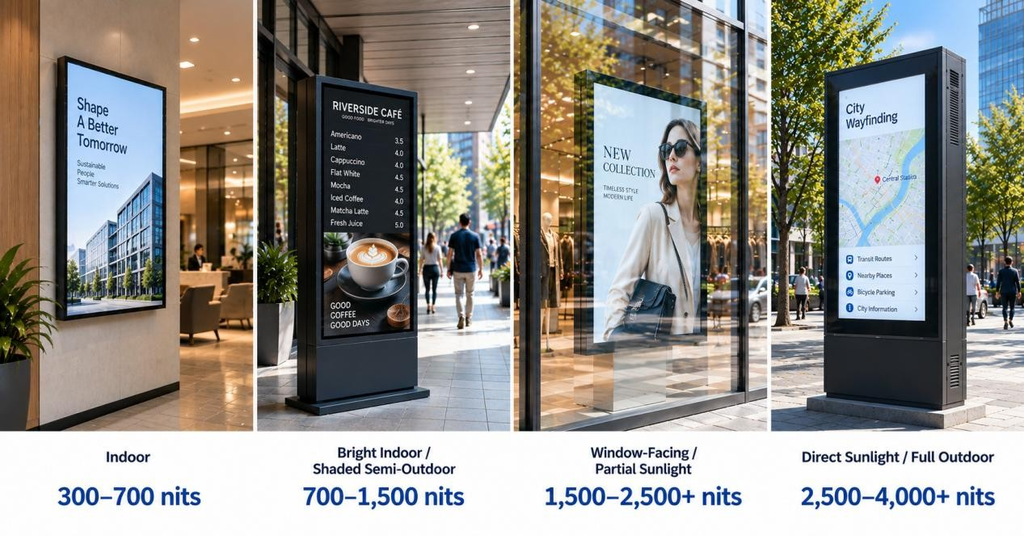
Nits are the standard measurement used to describe display brightness. A higher nit rating generally means that a display can produce more visible light. Typical indoor commercial displays may have brightness levels ranging from several hundred nits, while outdoor displays designed for direct sunlight may require significantly higher brightness.
For example, a display installed under a covered outdoor area may not require the same brightness as one positioned directly beneath the sun. Similarly, a screen facing away from direct sunlight may perform adequately with a lower brightness level than a display facing the strongest part of the sky.
When comparing displays, buyers should therefore look beyond the maximum brightness specification and consider the actual environmental conditions where the screen will be installed.
Direct Sunlight and Screen Visibility
Direct sunlight is one of the biggest challenges for outdoor LCD displays. Even a bright screen can struggle if it is positioned poorly or exposed to intense reflections. Screen placement should therefore be considered alongside brightness.
An outdoor display installed under an awning, canopy, or other shade structure may have improved visibility without requiring extremely high brightness. Anti-glare coatings and high-contrast panels can also help reduce the effects of reflections.
The direction of the screen is important as well. If possible, installers should consider the position of the sun throughout the day and avoid placing the screen where sunlight directly strikes the viewing surface for extended periods.
Daytime Versus Nighttime Operation
Another important consideration is that outdoor lighting conditions change dramatically throughout the day. A display that looks excellent in bright afternoon sunlight may appear excessively bright at night.
This is why many modern outdoor displays include automatic brightness adjustment. Sensors can detect changes in ambient light and adjust the screen accordingly. During the day, brightness can increase to maintain visibility. At night, it can decrease to create a more comfortable viewing experience and reduce unnecessary energy consumption.
Businesses operating displays around the clock should prioritize automatic brightness control. This feature can improve readability while also helping the screen adapt to changing environmental conditions.
Choosing Brightness for Different Locations
The ideal brightness level depends heavily on the location. A screen positioned beneath a covered entrance may have different requirements from a freestanding digital billboard exposed to direct sunlight.
Retail storefronts often need displays that remain visible through glass or in areas with significant daylight. Restaurants using outdoor menu boards may require strong brightness so customers can read information from a distance. Transportation facilities may need high-brightness screens because passengers need to see schedules and announcements quickly.
Sports venues, event spaces, and outdoor entertainment locations can also benefit from high-brightness displays. In these environments, viewers may be standing or moving rather than remaining in one position, so content needs to remain immediately noticeable.
This outdoor LCD display brightness guide highlights why there is no single brightness specification that works perfectly for every outdoor installation.
Contrast Is Also Important
Brightness alone does not determine visibility. Contrast plays an equally important role. A screen may have a very high brightness rating but still provide poor readability if its contrast performance is inadequate.
Strong contrast helps distinguish text, images, and graphics from their backgrounds. This is particularly important for digital signage because messages are often viewed quickly.
Content design also influences perceived contrast. Simple backgrounds, large fonts, and clear visual hierarchy can make information easier to read. Combining an appropriately bright display with well-designed content can produce significantly better results than relying on brightness alone.
Consider Heat and Weather
Outdoor LCD displays must deal with more than sunlight. Temperature changes, humidity, rain, dust, and other environmental conditions can affect display performance.
A display intended for outdoor use should have suitable protection against environmental exposure. Thermal management is particularly important because high brightness can generate additional heat. Proper cooling and ventilation help maintain stable operation and extend the life of the components.
Before installation, businesses should review the manufacturer’s operating temperature range and environmental protection specifications. A display designed specifically for outdoor environments will generally be better suited to demanding conditions than a standard indoor monitor placed outside.
Energy Efficiency and Operating Costs
High brightness can increase power consumption, especially when a screen operates continuously. Businesses with multiple outdoor displays should consider energy efficiency when selecting equipment.
Automatic brightness adjustment can help reduce power usage by lowering brightness when environmental lighting conditions permit. Efficient LED backlighting and intelligent power-management features can further contribute to lower operating costs.
Over several years of continuous operation, energy consumption can become an important part of the total cost of ownership. Selecting a display that balances brightness, efficiency, and durability can therefore provide better long-term value.
Planning Before Purchasing
Before choosing an outdoor LCD screen, businesses should evaluate the installation location carefully. Measure the available space, determine the expected viewing distance, identify potential sources of glare, and consider how much direct sunlight the display will receive.
It is also useful to consider the type of content that will be displayed. Large advertisements may have different requirements from detailed menus, schedules, maps, or informational messages.
This outdoor LCD display brightness guide shows that brightness should be evaluated as part of a larger set of specifications rather than treated as the only factor when purchasing an outdoor screen.
Getting the Right Balance
The best outdoor display is not necessarily the one with the highest brightness rating. Instead, businesses should look for a balanced combination of brightness, contrast, viewing angle, durability, environmental protection, energy efficiency, and content compatibility.
A high-quality screen should remain readable under the expected lighting conditions without becoming unnecessarily bright during darker periods. Automatic brightness adjustment, anti-glare technology, and suitable installation can all contribute to better performance.
For businesses comparing different models, this outdoor LCD display brightness guide can serve as a starting point for understanding why screen specifications need to match the actual environment.
Conclusion
Outdoor LCD displays can provide powerful communication and advertising opportunities, but their success depends heavily on choosing the right specifications. Brightness is one of the most important considerations because outdoor environments expose screens to significantly more ambient light than indoor locations.
Understanding nits, sunlight exposure, contrast, automatic brightness control, environmental protection, and energy consumption can help businesses make more informed decisions. Rather than simply selecting the brightest available screen, buyers should evaluate the specific installation environment and choose a display designed to perform reliably under those conditions.
With the right combination of brightness, placement, technology, and content design, outdoor digital signage can remain clear, attractive, and effective throughout the day and night.
