

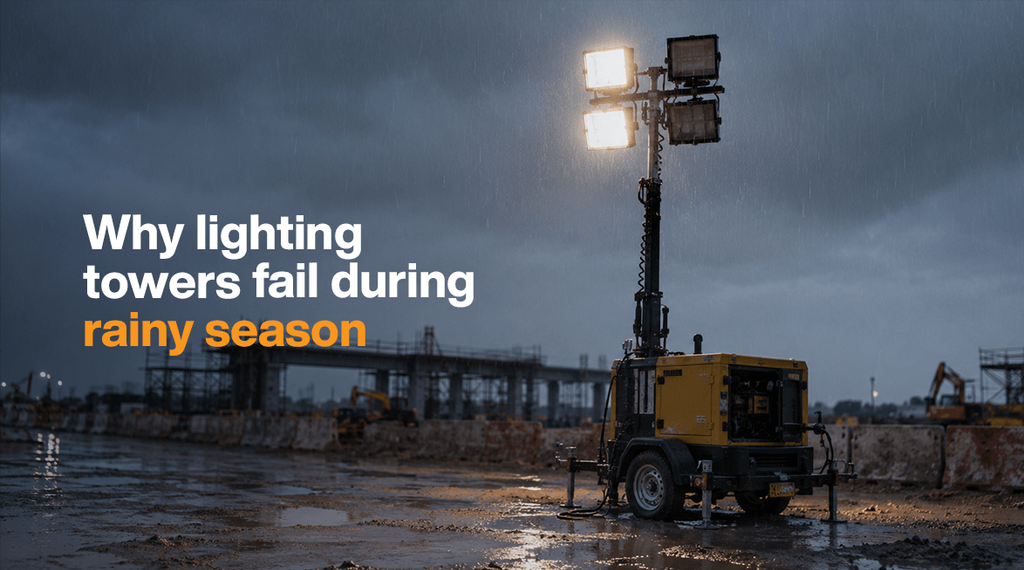
Rain alone does not make a lighting tower unreliable. During the monsoon, the most common causes of failure include water ingress, improper electrical connections, improper site placement, inadequate maintenance, unstable ground conditions, and an unsuitable power system for the application.
For project managers comparing lighting tower manufacturers, understanding these failure points is essential for maintaining safe, continuous illumination when construction, infrastructure and industrial work cannot stop.
7 Reasons Why Lighting Towers Fail During Rainy Season
1. Water Reaches Sensitive Electrical Components
The most apparent cause of failure of a lighting tower during heavy rain is the intrusion of water into inadequately protected components.
Electrical connections, sockets, lighting fixtures, batteries, or generator-related components that are positioned within or around the lighting tower, depending on the tower’s design. When rainwater enters an unprotected component, it can lead to short circuits, electrical breakdown, corrosion or unplanned shutdowns.
This is why the protection level of individual components matters rather than simply assuming that a tower is “rainproof.” The important distinction is that an IP rating applies to the specified component or enclosure; it should not automatically be interpreted as making every part of an entire lighting tower immune to every weather condition.
2. Wet Ground Creates Stability Problems
Rain changes the ground beneath a tower. Soil can become soft, muddy or uneven, reducing the reducing the stability of equipment with extended masts.
This becomes more significant when a tower is installed on an embankment, construction site, excavation area or recently disturbed ground. A tall mast exposed to wind creates additional lateral forces, making correct leveling and stabilization critical.
Modern lighting towers improve stability by using outriggers, stabilizer jacks, and towing or anchoring systems suited to the site and operating conditions. For example, Olikara’s Qube Power uses three stabilizer jacks on its outriggers and is specified for stability in wind speeds up to 80 km/h.
Thus, even a technically capable tower can become vulnerable if it is positioned on unstable ground or operated without proper levelling.
3. Poor Power Connections Become a Weak Point
Rainy conditions make temporary electrical installations need more attention. Water around cables, plugs and connectors can increase the consequences of poor installation practices.
This is particularly relevant for grid-powered towers. A grid-powered unit depends on an external electricity supply, so a well-designed tower is a better option. While the upstream connection, cable routing or temporary electrical installation becomes the actual point of failure.
Therefore, selecting a tower is only part of rainy-season reliability. Site electrical practices matter just as much.
4. Solar-Powered Lighting Towers Face a Different Monsoon Challenge
Solar-powered lighting towers do not usually fail because rain itself “switches off” the system. Their bigger challenge during prolonged cloudy weather is reduced solar energy generation.
A solar tower charges its battery through photovoltaic panels. When several days of heavy cloud reduce available sunlight, the energy harvested during the day can fall, potentially affecting available runtime if the stored energy is not sufficient for the required operating schedule.
5. The Wrong Power Source Can Create Operational Failure
Different worksites experience rain differently. A remote road project may not have dependable grid access, while a large industrial site may already have electricity available. A project that requires long operating hours may also have different priorities from a temporary urban application.
| Factor | Engine-powered | Grid-powered | Solar/Hybrid |
| External grid required | No | Yes | No for normal solar operation |
| Key Monsoon Concern | Engine/fuel and site conditions | External electrical connection | Reduced solar charging during prolonged cloud |
| Remote-site Suitability | High | Lower where grid is unavailable | High |
| Noise/emissions | Higher | No direct emissions at the point of use | Silent operation during solar-powered use. |
| Backup Potential | Engine provides independent generation | Dependent on grid | Hybrid systems combine batteries and diesel for backup power. |
| Application Areas | Infrastructure and remote works | Events, industrial areas, mine lighting | Railway yards, city works, remote areas |
An engine-powered example is Qube Power, which uses a 3 kVA diesel power source, features four 200 W LED lights and has a published runtime of 65 hours. For a larger project, Qube Power Max Hybrid combines a 7.2 kVAh battery pack and three operating modes.
A grid-dependent application provides another example. Qube Grid Max uses an external grid supply, six 400 W LED lights and illuminate up to 8,000 sq. m. It also incorporates circuit breakers and an IP65-rated output socket.
6. Corrosion Slowly Reduces Reliability
A lighting tower can be damaged by moisture even when it continues to operate normally.
Exposure to moisture can cause accelerated corrosion, especially in muddy, humid or industrial environments where equipment is used repeatedly. Metal structures, fasteners, electrical contacts and mechanical parts can corrode over time.
Material selection and surface treatment therefore become important. A hot-dip galvanized mast is designed to provide protection against rust and abrasion. These features demonstrate an important principle: rainy-season reliability is created through many small engineering decisions rather than relying on a single waterproofing feature.
7. Design Matters More Than Marketing Claims
Buyers should not consider any broad claims from lighting tower manufacturers or lighting tower suppliers such as “all-weather” or “heavy-duty”.
The more useful questions are: Which components have specified ingress protection ratings? How is the mast protected against corrosion? What stabilisation system is provided? How does reduced sunlight affect battery charging and operating runtime? How is power protected? What operating conditions has the equipment been designed to handle?
For instance, Olikara’s Qube Solar is specified with five stabilising jacks and stability up to 100 km/h wind speeds, while the Qube Grid Max uses six stabilization points and is specified for stability up to 120 km/h.
These specifications provide a more meaningful basis for assessing equipment than simply judging a tower by its appearance.
How to Prevent Rainy-Season Lighting Failures
The best approach is to consider the tower and the site as a part of an integrated system. Proper equipment selection, installation, positioning, electrical safety and maintenance all contribute to uptime.
A project manager should therefore select a tower based on available power, anticipated rainfall, operating hours, ground conditions, lighting requirements, and mobility needs.
For instance, a remote highway project can be powered by an engine or hybrid system, while a location that has a reliable power grid may prefer a grid-powered system. Where reducing fuel consumption is important and the operating profile permits it, a solar-powered lighting tower can be considered with sufficient battery capacity and an appropriate contingency plan.
Conclusion
Lighting towers rarely fail in the rainy season simply because it is raining. The most common failures tend to appear when electrical safety, stability, corrosion resistance, energy availability, maintenance and site conditions are not taken into account.
India’s southwest monsoon is at 108% of its long-period average in 2025, making it crucial to prepare a temporary lighting system for the harsh weather conditions. The equipment should be chosen based on the worksite rather than using a one-size-fits-all solution.
Olikara Lighting Towers, your trusted lighting tower supplier, offers solar-powered and hybrid lighting tower solutions designed for applications ranging from infrastructure and city works to railway yards, mining and industrial environments.
FAQs
1. Can lighting towers operate safely during heavy rain?
Yes, lighting towers can operate safely in heavy rain when the equipment, electrical connections, installation, and operating conditions are suitable for wet environments. Protection ratings and proper site practices are essential for reliable operation.
2. Does rain reduce the performance of solar lighting towers?
Prolonged cloud cover during rainy weather can reduce solar charging, affecting battery capacity and operating runtime.
3. Which lighting tower is better for remote rainy-season projects?
Engine-powered or hybrid systems can be suitable where grid electricity is unavailable or where continuous operation is critical. The final choice should depend on site conditions and operating requirements.
4. How can lighting tower failures be reduced during monsoon?
Use appropriate electrical protection, inspect equipment regularly, maintain stable ground conditions and select a tower whose power source, stability and operating specifications match the project.