

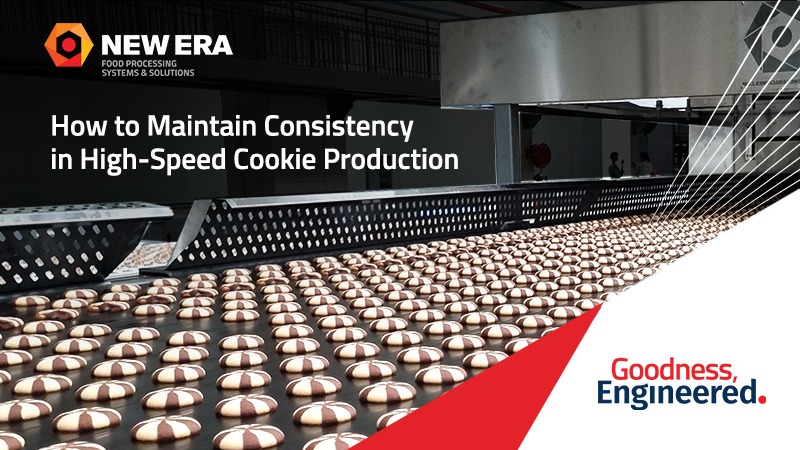
A cookie can be made in seconds, but making thousands of identical cookies every hour is a challenge. Even a slight change in dough temperature, ingredient ratios, oven temperature, or cooling time can turn an entire batch of products into a nightmare in just minutes.
For commercial bakeries, consistency is not simply about looks. It impacts texture, weight, colour, taste, packaging, customer expectations and ultimately the brand reputation. Manual corrections are harder to keep track of as production volumes grow. The solution is to design a controlled environment for production where all the stages are interdependent and work in harmony with one another.
Modern automated systems are based upon this principle. Every process, from controlled mixing and automatic feeding to automated precision forming, multi-zone baking, cooling and post-baking handling, has to be consistent with the same quality objective.
So, how can manufacturers maintain consistency while operating at high speed?
Build Consistency into Every Stage of Production
1. Standardise Recipe and Ingredient Control
Uniformity starts from the very beginning, before the dough gets to the forming machine. The behavior of the dough can vary, which can impact the final cookie.
Recipe management systems can help operators to keep the defined ingredient ratios and process parameters. Accurate weighing, controlled mixing time and repeatable batch procedures minimise the risk of human error.
Recipe standardisation is especially relevant when manufacturing at high speed, since a small error may be multiplied across thousands of cookies.
2. Control Dough Temperature and Mixing
The viscosity, spread, machinability and the final texture of a dough are directly affected by dough temperature. Horizontal mixing systems can be automated to allow for controlled mixing time and dough temperature, with a large batch volume.
For instance, a large capacity mixer, for industrial cookie production, can hold a batch from 70 kg up to 1,000 kg, and recipe controls ensure repeatability between batches.
The purpose is to blend the ingredients well, but most importantly, to obtain a dough that has consistent properties each time.
3. Handle Different Dough Types with the Right Forming Technology
Not every cookie dough behaves in the same manner. Handling time for soft and high-fat doughs is different from firmer doughs and much different from doughs including inclusions or fillings.
That is why manufacturers require systems that can handle different dough types without sacrificing speed or product definition.
For instance, wire-cut systems are ideal for creating defined cookie dough shapes from soft cookie dough; depositors can handle semi-liquid or soft batters, and extruders can create bars or sticks from soft batters before cutting.
4. Synchronise Forming Speed with Baking
You can achieve the benefits of a fast forming machine only if the oven can process the output consistently. When the forming system operates at a higher speed than the baking section, the forming and baking conditions may become unstable. If it is too slow, production capacity is unnecessarily limited.
Synchronisation is considered crucial between forming, oven speed, and conveyor movement.
A multi-zone temperature system can be utilised in industrial baking systems to control heat distribution and ensure uniform colour, moisture and texture. Precise controls on the oven enable manufacturers to tailor a baking profile based on cookie thickness, formulation and desired cookie finish.
5. Monitor Moisture, Colour, Weight, and Shape
It is not enough to rely on an operator’s visual inspection to ensure high-speed production of any cookie. Hundreds or thousands of pieces may already have been produced by the time a problem is realised.
Rather, manufacturers should define measurable quality parameters, like:
- Cookie weight and dimensions
- Dough thickness
- Baking temperature
- Moisture content
- Surface colour
- Texture
- Product spacing
- Cooling temperature
Sensors, automated controls and quality-monitoring systems can detect deviations sooner and give operators time to make necessary adjustments before a minor problem turns into a major production loss.
6. Maintain Smooth Cooling and Post-Baking Flow
Baking can determine the texture of a cookie, but cooling can dictate whether or not that texture is preserved until made ready for packaging.
It is therefore important that the cooling conveyors are properly synchronised with the oven output and downstream equipment. Modern post-baking systems enable the incorporation of cooling conveyors, turntables, stackers, packing tables and flow control equipment to ensure a better transition from the oven to packing.
7. Make Preventive Maintenance Part of the Production Strategy
No matter how advanced the cookie manufacturing line, it is impossible to achieve consistency if the components are worn, misaligned, contaminated or poorly calibrated.
The mixers, feeding systems, forming equipment, conveyors, burners or heating elements, sensors, belts, controls and packaging interfaces should be included in preventive maintenance. Unusual vibration, temperature variation, product build-up, and forming irregularities should also be observed by the operators.
Cleaning is also a major factor. Production areas should be planned to reduce the risk of food contamination and food contact surfaces must be accessible and hygienic.
Why High-Speed Cookie Production Requires an Integrated Approach
The biggest error that a manufacturer can make is to think of each machine as a standalone unit. The whole process should function as a single system for optimal high-speed production.
Let’s say that a production line is manufacturing a soft cookie with a high inclusion content. The mixing machine must ensure the dough is mixed properly, the feeding system must ensure the dough is fed at a controlled rate, the forming system must ensure that the dough’s structure is preserved, the oven must be designed to allow for the thickness and moisture profile of the dough and the cooling system must ensure that the dough is cooled before packaging without adversely affecting the end product.
A problem at one stage can cause problems throughout the line. Integrated automation assists in removing such gaps.
This is particularly useful when multiple SKUs are manufactured. Recipe settings and machine parameters can be set systematically instead of depending on a lot of manual work in each product changeover.
The Market Reality: Consistency is Becoming More Important
The scale of the bakery industry in India is clear enough to show the importance of the efficiency and consistency of production. As a matter of fact, India’s bakery industry is projected to reach around US$ 32.05 billion by 2034, representing a projected CAGR of 8.76%.
The numbers reflect a basic rule of any business: the larger the market, the more units a manufacturer must manufacture without compromising quality.
This is why automation, process control, flexible forming technology and reliable Cookie production line manufacturers are becoming more important for industrial bakery operations.
Conclusion
Increasing machine speed alone is not the key to consistency in high-speed cookie production. Integrated systems that offer flexibility and precision are crucial for manufacturers aiming to handle different dough types efficiently.
Experienced cookie production line manufacturers help companies match the capabilities of their equipment to their recipes, throughput requirements, product selection and future growth plans.
New Era, having decades of engineering knowledge and advanced production solutions, enables manufacturers to create efficient, scalable, and quality-oriented cookie production lines that meet the challenges of today’s bakery environment.
FAQs
1. Why is consistency difficult in high-speed cookie production?
The high production rates amplify the variations of the dough, forming, baking and cooling. These variations can be reduced through the use of automated controls and synchronised equipment.
2. How can manufacturers handle different dough types?
Flexible forming technologies such as wire-cut, depositing, and extrusion systems) can be used by manufacturers depending on the dough properties, inclusions, and fillings.
3. How does baking affect cookie consistency?
Colour, texture and crispness are directly affected by temperature distribution, baking time, moisture removal and the conveyor speed. Multi-zone ovens help to maintain controlled baking conditions.
4. What should manufacturers look for in Cookie Production Line manufacturers?
Search for engineering skills, flexibility of the machinery, automation, hygienic design, reliable after-sales service, scalability, and a customisable line that can be tailored to recipes and production needs.