

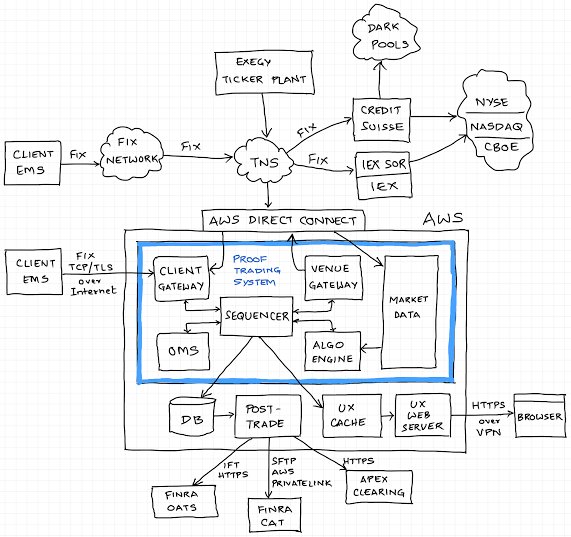
When a human trader manually executes a few positions a day, tracking minor fractional pip movements might feel like a secondary concern. The mathematical landscape changes completely when you cross over into the realm of programmatic and algorithmic execution. Automated trading systems rely heavily on absolute, friction-free environments to maintain their underlying probability curves over hundreds of sequential iterations. For developers and systematic strategy builders, finding a workspace configured for raw, ultra-tight decimal limits is a core operational requirement.
The digital infrastructure mapping automated execution loops down to interbank networks. Source: Medium
What exactly constitutes a micro-spread in automated trading environments?
A micro-spread represents a highly compressed bid-ask gap that sits near or exactly at absolute zero pips during peak market volume crossover hours. The bid is the highest current price coordinate a buyer offers to absorb a contract, and the ask is the lowest entry target a seller demands to yield an asset.
The physical space between these metrics behaves exactly like an upfront, non-negotiable transactional toll or a processing fee paid the precise millisecond an order executes. Retail account structures usually add an artificial markup block to this gap to build a broker margin. Micro-spread architectures completely strip this retail layer away, passing the raw wholesale lines directly to your charting panel so your automated scripts can interact with the market’s true structural boundary.
Why does a minor fractional pip difference impact an electronic algorithm so severely?
Human market swing traders targeting wide, multi-day movements can comfortably absorb a padded retail markup because a one-pip drag is noise inside a hundred-pip profit target. Automated code engines, conversely, look to harvest thousands of quick, repetitive micro-inefficiencies throughout a single session.
Because an algorithmic target might only look to lock in a profit boundary of two or three pips per turn, a padded retail markup of 1.5 pips acts like a sudden tax that swallows up over half of the strategy’s gross yield instantly. Deploying your systematic strategies inside an environment backed by competitive low spread forex brokers ensures this hidden financial drag remains completely minimized. Protecting those minor pip fractions preserves your script’s mathematical edge, keeping your capital compounding securely within your ledger parameters.
If the visual pricing gap drops to zero pips, how am I charged for execution?
No electronic exchange network operates as a non-profit charity, meaning that when a platform removes the retail markup from the bid-ask spread, it must adapt its underlying billing structure. It may replace the floating visual buffer by charging a flat, transparent commission fee per traded lot instead. Regardless of the fee structure, traders should also understand common day trading chart patterns to better evaluate potential setups and avoid allowing transaction costs to overshadow sound market analysis.
This unbundled format gives your automated code absolute cost predictability before an execution ticket ever transmits down the server line. For an honest look at how these distinct fee structures impact your net portfolio values over massive sample sizes, spending time reviewing what is a spread in trading gives you the baseline metrics to optimize your algorithm’s profit calculations. For high-velocity systems, an upfront commission paired with zero pips is always vastly superior to managing a slippery, floating retail gap.
How do micro-spreads lower my strategy’s win-rate requirements?
Unoptimized transaction charges place a heavy, invisible weight on your algorithm’s statistical performance, quietly forcing your script to maintain an unsustainably high win rate just to break even. Symmetrical cost drag warps your code’s risk ratios behind the scenes.
If your automated script executes an intraday position with a tight 5-pip stop-loss and a 10-pip take-profit target, a padded 1.5-pip retail spread alters those parameters instantly upon entry. Your real downside exposure expands to 6.5 pips, while your realistic upside target drops to an effective 8.5 pips. Your pristine 1:2 risk-to-reward ratio has degraded into a far less competitive 1:1.3 model. Transitioning to micro-spread parameters stops this structural decay, allowing your technical entry rules to function exactly as you backtested them.
Can choosing specific frontend software enhance my automated pricing precision?
All the institutional pricing depth and micro-spread aggregation layers in the world mean very little if your localized terminal suite suffers from internal code lag. Basic, single-threaded software options create major processing bottlenecks, failing to handle thousands of rapid decimal updates when volume surges during major session crossovers.
Running your automated portfolios through a specialized, multi-threaded workspace, such as the best forex broker for mt5, ensures your frontend can keep pace with live interbank price adjustments. Advanced platforms utilize enterprise-grade communication gateways that handle deep market data streams effortlessly without freezing up. This structural stability ensures your expert advisors, indicator scripts, and protective targets transmit instantly, letting you capture raw wholesale numbers before the order book can shift.
Why do micro-spreads occasionally expand during high-impact macroeconomic news drops?
The central matching ledger behaves exactly like a live thermometer for global financial risk, meaning it responds dynamically to intense real-time liquidity changes. When high-impact news hits the economic calendar, institutional market makers face massive pricing uncertainty.
To protect their corporate balance sheets from sudden, unhedged price gaps, automated banking algorithms quickly pull their resting limit orders out of the matching ledger. This rapid programmatic retreat leaves a hollow order book behind inside the centralized exchange framework. When an incoming retail market order hits this sparse ledger, the platform has to travel across multiple empty pricing layers to secure a complete fill, causing the active spread to expand defensively like a rubber band. Advanced algorithmic systems monitor this liquidity drop in real time, pausing execution parameters automatically until the data shock clears.
Practical Action Plan
Stop evaluating your automated trading frameworks based on simple visual backtests or superficial marketing slogans. Open your developer console this weekend, extract the precise execution log history from your past thousand trades, and calculate your exact dollar loss down to fractional pips across variable session hours. By migrating your programmatic scripts away from delayed retail accounts to an unbundled raw account configuration, and utilizing a Virtual Private Server co-located next to your broker’s primary data hub, you can eliminate structural transaction drag and run your algorithm business with absolute mathematical control.
