

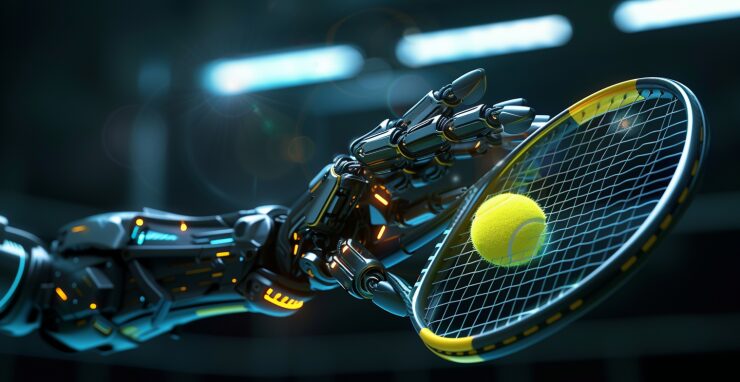
Artificial intelligence (AI) is changing the game of tennis in many ways. AI-powered gadgets are enhancing training and honing the performance of players. AI provides real-time match analysis and more precise line-calling. Immediate, actionable knowledge gives players who use it a distinct competitive edge.
AI in tennis training
Players today may train in environments that simulate real matches with virtual opponents. Smart rackets and sensor-based equipment provide immediate feedback on swing speed, accuracy, etc. This gives players insights they can use to improve their performance. Tennis coaches also use these data insights to help players correct their techniques. This leads to more focus in training sessions and quicker improvement. Mental coaching tools powered by AI can also help players to develop strategies to handle high-pressure situations. This can improve their mental resilience on the court.
AI is also upgrading the experience of online sports betting. Sports bettors use it when betting on tennis for data analysis, generating predictions, and identifying ‘value bets.’
Real-time match analysis
AI tools offer real-time analysis during matches. It can track player movements, shot selections, and patterns. Players can identify the tactics their opponents are using and adjust their playing styles accordingly. Coaches can also use the data to make suggestions to players that could change the outcome of a match.
For example, a coach may advise a player to target a weak backhand of an opponent. He may advise the player to act more proactively by approaching the net more often if the opponent tends to play mostly from the backline.
The data captured during a match can help with analyzing play post-match. This helps to accelerate the learning process for players and prepare them for future matches. Using AI in this way is likely to make a significant impact on many spheres, including the sports world.
Automated officiating
AI is making its mark on officiating in tennis. Wimbledon and other Grand Slam tournaments use the Hawk-Eye Live system. Many high-speed cameras all around the court follow the ball trajectory. The system determines whether shots are in or out with an accuracy that human line judges don’t have. This minimizes errors and disputes, making the game fairer and reducing controversies that could affect the match outcome.
Predictive injury management systems
These systems help to safeguard the health of players. AI sensors and wearables monitor biometric and physical activity. By examining trends in the data, AI models can identify signs of stress that precede common tennis injuries like knee sprains. Coaches can then adjust training regimens.
Equipment customization
By analyzing specific attributes of a player’s style, AI can recommend adjustments to racket specifications. It can sense handling dynamics and preferences through sensor data. This can improve the comfort level for players and reduce the risk of injuries.
A superior fan experience
AI in sports is transforming the fan experience, and tennis is no exception. AI can control the cameras that follow the action on the court. It can focus the cameras at crucial moments, such as a tense rally or tiebreak.
Other ways AI can provide a superior fan experience:
- Predictive insights add excitement and strategic depth for viewers, providing a deeper understanding of the strategies and skills of players.
- AI algorithms analyze fan preferences and viewing habits to provide them with custom highlight reels and personalized updates.
- Fans can ask AI assistants on tennis apps questions, and they will receive quick responses.
- AI-driven features like live captions and language translations make tennis match commentary accessible to wider audiences.
Fans can engage on social media at optimal times as AI can analyze engagement patterns. They can generate highlight reels using AI and post them. This ensures they get maximum visibility and interaction.
Scouting and recruiting players
AI-driven tools can analyze data from countless matches to pick up emerging talent. The tools will assess everything from the adaptability of players to different playing surfaces to their improvement rate and their psychological resilience. This enables scouts and talent agencies to find and nurture players with potential. Recognizing them early on gives them an opportunity to improve quickly and advance their careers.
